When hiring slows, the real talent work begins.

The economic slowdown across DACH is forcing organisations to reduce external hiring. The smartest among them are using the pause to do something far more valuable: identify the leaders already sitting within their business.
A particular kind of silence settles over a talent acquisition team when the hiring budget is cut. The job boards go quiet. Agency relationships go on pause. Recruiters who spent years chasing passive candidates now spend their days managing a shrinking pipeline of live roles.
That silence has been spreading across Germany, Austria and Switzerland throughout 2026. And if you are leading HR or talent in a bank or insurance company in the DACH region, it is already shaping your agenda for the year ahead.
The question is what you do with it.
The economic reality: what the numbers actually say.
Germany entered 2026 after three consecutive years of contraction or near stagnation. The ifo Institute’s Autumn 2026 forecast, published on 3 September, projects GDP growth of 1.4% for the full year. A meaningful upward revision, but one that masks a labour market that is still tightening. Recovery is under way; its benefits for hiring have not yet arrived.
Germany’s registered unemployment rate averaged 6.5% through August 2026, with 3.061 million people registered as unemployed. The highest level since 2010. Employment fell slightly in July 2026, with 45.48 million people in work – down from a peak of 46.09 million in late 2024. Month after month, the adjusted employment figure has drifted lower.
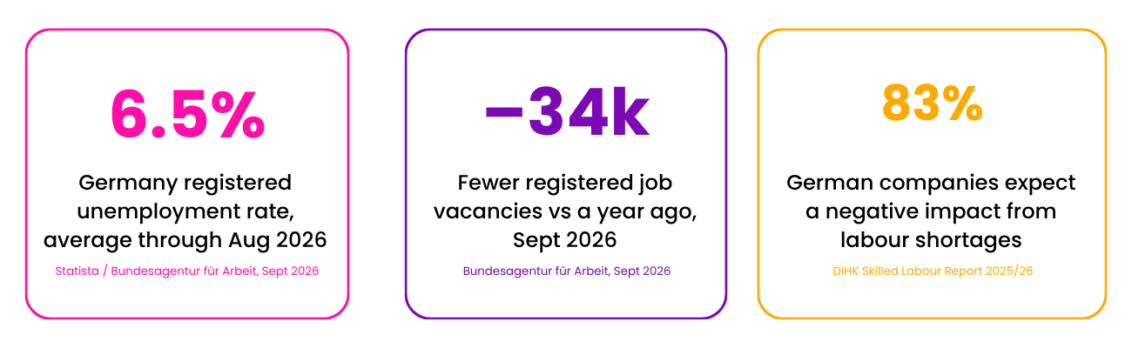
The picture is structurally paradoxical, and that paradox defines the challenge for every HR leader in the region. Germany simultaneously faces shortages across 163 occupations while overall vacancy demand has dropped. The OECD Employment Outlook 2026 identifies Germany as the country where labour market tightness has decreased the most across all OECD members, falling to 0.3 vacancies per unemployed person, below pre-crisis 2019 levels. External recruitment has slowed. Internal talent has never mattered more.
For banking and insurance specifically, the pressure is compounded by regulatory complexity. DORA went live in January 2025. The EU AI Act started enforcing prohibitions in February 2025. Every new regulatory layer raises the bar for who can lead effectively in this environment. And that bar cannot be cleared by external hiring alone when the external market is contracting.
The internal talent crisis no one is measuring.
Here is the uncomfortable truth that sits beneath most HR strategies in financial services: most organisations have no reliable way to assess the leadership potential of the people already inside their business.
They have performance reviews, manager recommendations… And they have the informal politics of who gets visibility and who does not. What they rarely have is an objective, structured view of personality, leadership readiness, risk factors and development potential across their talent population.
52% of banks say they would be likely to hire senior talent from outside the institution to strengthen leadership. Even when the economic case for external hiring has weakened. The reason is not preference. It is data. They simply do not have a clear enough picture of who is ready inside.
“Internal mobility and career pathing are receiving renewed attention as banks recognize the value of retaining top talent. 93% of employees say they are more likely to stay with an organisation that invests in their career development.“
The cost of that visibility gap is significant, not only in succession risk but in day-to-day development decisions made on instinct rather than insight. Who gets the stretch assignment? Who gets the leadership programme? Moreover, who is told they are ready for the next level, and who is quietly managed out of the frame?
Those decisions shape your leadership pipeline for the next decade, and right now most organisations are making them without adequate data.
What the economic slowdown actually makes possible.
A hiring pause is not a failure. For organisations that use it intentionally, it is an opportunity that periods of active hiring rarely allow.
When external recruitment is running at full speed, the talent development function is often reactive: identifying replacements for open roles, running training for people who have already been promoted, processing development needs as they arise. There is little time for the structural work: mapping your actual talent landscape, identifying high-potential leaders before they are needed, building succession depth in the roles that matter most.
The slowdown creates that time. The organisations that will emerge strongest from this economic cycle are those that use the pause to do three things:
Map the landscape objectively
Conduct a structured personality and leadership readiness assessment across your mid-level population. Not just the people already on the HiPo list, but the full cohort of people who could be. You will find leaders you did not know you had. You will also uncover risk factors you did not know existed.
Build development that actually sticks
Generic leadership programmes have notoriously weak ROI. Personality-based development — built around an individual’s actual profile, strengths, and risk areas — shows effect sizes of d = 0.50–0.60, among the highest of any HR intervention. The investment is smaller; the impact is significantly larger.
Create a shared language for potential
The most common failure in succession planning is not a lack of candidates; it is a lack of alignment. HR, the board, and line managers all have different intuitions about who is ready. A common diagnostic framework creates a shared vocabulary that makes those conversations faster, fairer, and more defensible.
The banking and insurance case: why this sector specifically?
According to Aon’s 2026 Human Capital Outlook, the insurance sector is facing a confluence of pressures – digitalisation, AI integration, regulatory complexity, and demographic change. That is fundamentally reshaping what effective leadership looks like. Technical expertise alone is no longer sufficient. Leaders who will navigate this environment successfully need high self-efficacy, strong conscientiousness for regulatory compliance, resilience under sustained pressure, and the ability to build and hold together diverse teams.
Those are not skills that appear on a CV. They are personality dimensions. And The Institutes Knowledge Group’s 2026 Skills Report confirms that insurance organisations are increasingly looking for talent with adaptable, human-centric skills such as strategic thinking and communication. Precisely the dimensions that standard performance reviews are least effective at capturing.
In banking, 87% of financial firms were already using skills-based hiring by 2024, moving away from credentials towards what one BCG Managing Director described as “will and skill”. The same logic applies internally. The question is not what level someone is at, but whether they have the personality profile to lead effectively at the next level. In this regulatory environment, with this team composition, under this level of pressure.
The counter-arguments, and why they do not hold.
Every time the case for structured personality diagnostics is presented to a senior decision-maker in financial services, the same objections appear. They are understandable. They are also consistently unsupported by evidence.
“We have been identifying leaders for decades without any tool. Our managers know their people.”
Research consistently shows that unstructured managerial assessment has a predictive validity of r = 0.20 — barely above chance. The problem is not that managers do not care. It is that they are systematically influenced by similarity bias, recency bias, and halo effects.
The person who presents well in Monday’s team meeting and the person who will perform under sustained regulatory pressure in a crisis are not always the same person.
“This is a cost we cannot justify in the current economic environment.”
The cost of a mis-hire at senior level in financial services typically runs between 150% and 300% of annual salary — before accounting for regulatory risk exposure. The cost of a structured diagnostic assessment is a fraction of one month’s salary.
The economic argument runs exactly the other way: the current environment makes precision more valuable, not less.
“Personality tests are not reliable. People can game them.”
NLP-based free-text assessments — which analyse how people actually express themselves rather than how they answer closed questions — are significantly harder to game. The scientific literature on Big Five personality and leadership performance spans over 30 years and hundreds of studies.
Their validity is not in question. The question is whether your organisation is using them.
“We already know who our high potentials are.”
Most HiPo lists in large financial services organisations represent between 5% and 10% of the population. Independent diagnostic assessments consistently identify capable individuals outside those lists and flag risk factors in people on them.
If your current process never surprises you, that is a signal that it is confirming existing beliefs rather than generating new insight.
What this looks like in practice.
The organisations navigating this moment most effectively are not treating the hiring slowdown as a pause. They are treating it as a strategic window, and they are moving deliberately through it.
In practice, that means running structured personality assessments across a defined cohort – typically mid-level leaders and high-potential candidates – using a validated framework that covers personality dimensions, leadership style, entrepreneurial capital, and risk indicators. The output is not a ranking; it is a richer, more honest picture of your actual talent landscape: where the depth is, where the gaps are, and where the risk sits.
That picture then informs three decisions that are typically made on intuition: who receives development investment, who is ready for succession, and where team dynamics need to be addressed before they become performance problems.
For banking and insurance leaders specifically, this framework also provides something regulators are increasingly asking for: documented, evidence-based processes for leadership appointment decisions. In a world of heightened supervisory expectations around governance and fit-and-proper requirements, the ability to demonstrate that leadership decisions were based on objective grounds, not just manager recommendations, has real regulatory value.
The best time to build your leadership pipeline was five years ago. The second-best time is now, while the market is quiet enough to let you do it properly.
The bottom line.
The economic slowdown across DACH is real, sustained, and unlikely to resolve quickly. A hiring freeze in Germany rarely looks like a flashy mass layoff. It looks like open roles that stay open, requisitions that are withdrawn, and budget lines that are rolled into the next year. For most HR leaders, that means fewer opportunities to bring in external talent. And more pressure to do more with the people already inside.
Organisations that use this period to build genuine, objective visibility into their internal talent will emerge from the economic cycle with a structural advantage. Those that wait for the market to recover before investing in development will find they have lost ground they cannot quickly regain.
Talent does not sit still. It either develops, or it leaves for the organisation that offers it a clearer path.
ZORTIFYGROW · ZORTIFYLEADER
Find the leaders already inside your organisation.
Zortify’s personality diagnostics give HR and leadership teams an objective, evidence-based view of development readiness, succession potential, and leadership risk, across all levels of your organisation.
Prof. Dr. Florian Feltes
Prof. Dr. Florian Feltes is co-founder and co-CEO of zortify and a forerunner in AI-supported HR innovation. Together with his team, he develops intelligent personality diagnostics and helps companies identify the perfect candidates—without expensive assessments and without bias. His vision: a world in which every company can effortlessly form high-performance teams and create work environments that allow human potential to flourish.


The World Cup does not reward the best players; it rewards the best teams.

Amazon enters recruiting. Should HR be impressed or concerned?