The Sales Gene – does it actually exist?

We have been hiring salespeople incorrectly for decades. Not because we lack talent, but because we have been searching for the wrong qualities.
Imagine the salesperson you would hire tomorrow. You probably already have an image in mind: confident, charismatic, outgoing, quick-witted. Someone who lights up a room and turns strangers into customers before the coffee goes cold.
That image is costing companies millions every year.
The “born salesperson” is one of the most persistent – and most expensive – myths in hiring. It influences who gets shortlisted, who receives the offer, and who leaves within six months. Because the myth feels so intuitive, it is rarely questioned.
Research has been challenging it for over thirty years. It is time the hiring process caught up.
The myth has a name – and a weak correlation
Ask most sales managers what makes a great salesperson, and extraversion is mentioned within the first thirty seconds. The gregarious, people-oriented personality. High energy. Natural conversationalist. Loves being around others.
The science presents a more complex picture. Research on the Five Factor Model of personality and sales performance has found that conscientiousness and openness are positively related to sales outcomes, while extraversion shows no statistically significant relationship. Meta-analytic evidence, spanning decades and hundreds of studies, consistently places extraversion’s predictive value for sales performance at around rho = 0.15. That is modest at best.
To put this in context: this is roughly half the predictive power of conscientiousness, and less than half the predictive power of self-efficacy. The person you overlook because they seemed too quiet in the interview may well be the one who outperforms everyone in six months.
“Conscientiousness showed consistent relationships with all job performance criteria for all occupational groups studied.”
Barrick & Mount · Personnel Psychology — 162 studies, N = 42,887
So if it is not extraversion, what actually predicts sales success?
Decades of research – including Zortify’s own validation study —consistently point to five dimensions. None of these are visible in a CV. Most are invisible in a standard interview. All are measurable.
Not confidence in the sense of bravado — but the internal conviction that you can handle what comes at you. In sales, it determines what someone does after the tenth rejection in a row.
Self-discipline, reliability, and the tendency to follow through. In regulated environments like financial services and insurance, it is not just a performance predictor — it is a compliance safeguard.
Not blind positivity — but a realistic, proactive attribution style. Someone with high optimism reads setbacks as temporary and draws lessons rather than resignation. In commission-based sales, it is a survival prerequisite.
The ability to bounce back after setbacks. The World Economic Forum lists resilience as a top-three future skill. In sales, it has always been critical. The good news: it is trainable, with effect sizes of d = 0.50–0.60.
Yes, it matters. No, it does not matter as much as you think. Ambiverts often outperform high extraverts in many sales roles. Hiring exclusively for the ‘born salesperson’ systematically overlooks candidates with higher actual performance potential.
The cost of getting this wrong
This is not an abstract academic debate. Every time a company hires on gut feeling and the wrong profile, the financial consequences are immediate and compounding.
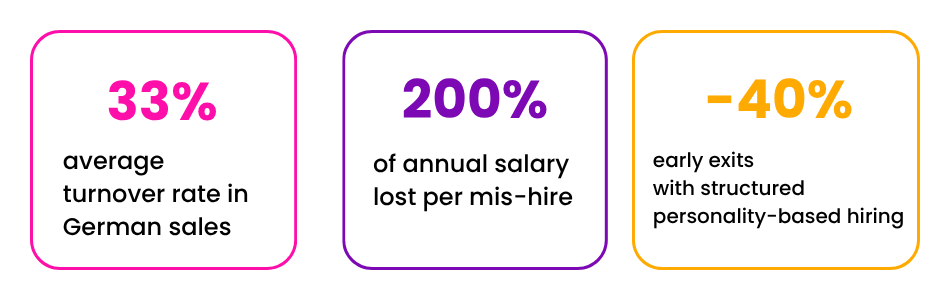
The first-year attrition rate in insurance and financial services structural sales is among the highest of any sector. Research consistently shows that performance and well-being are best ensured when sales personnel can work with their strengths rather than their weaknesses – which means identifying those strengths before hiring, not six months later.
Companies that implement structured, personality-based selection processes consistently reduce early turnover by 25 to 40 percent. Not by hiring better people, but by making better decisions about the people they already have in front of them.
Three traits that appear to be strengths – but are not
Beyond the five positive dimensions, research identifies three behavioural risk factors that require specific attention in sales hiring, particularly in regulated industries. These are dangerous precisely because they can appear to be strengths in an interview.
High narcissism can present as charisma and drive. Manipulative tendencies can resemble persuasiveness. Impulsivity can seem like decisiveness. In the short term, these traits may produce results. In the longer term, they generate customer complaints, regulatory exposure, and toxic team dynamics – the kind that quietly erode culture and cost far more than any individual mis-hire.
Standard unstructured interviews are almost entirely blind to these risks. The Five Factor Model provides important insights into personality traits that work well within sales environments, but capturing the full picture requires looking beyond surface behaviour into the underlying personality structure.
So, does the sales gene exist?
Not in the way we imagine. There is no single trait, no charisma factor, no genetic lottery ticket that determines whether someone will succeed in sales. What does exist is a measurable personality profile – five dimensions that consistently differentiate top performers from early quitters, across industries, cultures, and thirty years of peer-reviewed research.
The good news is that three of these five dimensions are trainable. Self-efficacy, optimism, and resilience can all be developed through targeted interventions, with effect sizes (d = 0.50–0.60) representing some of the highest returns on investment of any HR development measure.
The implication is clear: companies that measure these dimensions at the point of hiring make better selection decisions. Companies that develop them after hiring retain better employees. Companies that do both stop treating turnover as inevitable and start treating it as the preventable outcome it actually is.
Sources
Barrick, M.R. & Mount, M.K. (1991). The Big Five personality dimensions and job performance. Personnel Psychology, 44(1). Link
Avey, J.B., Reichard, R.J., Luthans, F. & Mhatre, K.H. (2011). Meta-analysis of the impact of positive psychological capital. Human Resource Development Quarterly, 22(2). Link
Luthans, F. & Youssef-Morgan, C.M. (2017). Psychological capital: An evidence-based positive approach. Annual Review of Organizational Psychology. Link
Kottirre, J. & Blickle, G. (2024). Conscientiousness and sales performance. Personality and Individual Differences, 232. Link
Brandt, C. (2025). Personality and sales — customising careers for salespeople. Athens Journal of Psychology, 1(2). Link
Heidbrink, M. & Feltes, F. — Zortify Validation Study (2023–2025). Internal research, callcentre sales environment
FREE WHITEPAPER
Das Vertriebs-Gen
The full research behind the five dimensions – with practical recommendations for selection and development. Available in German.
Prof. Dr. Florian Feltes
Prof. Dr. Florian Feltes is co-founder and co-CEO of zortify and a forerunner in AI-supported HR innovation. Together with his team, he develops intelligent personality diagnostics and helps companies identify the perfect candidates—without expensive assessments and without bias. His vision: a world in which every company can effortlessly form high-performance teams and create work environments that allow human potential to flourish.


The mis-hire is not the problem. Not knowing what it costs you is.

Beyond AI Support: Why HR Must Become a Decision Architect