The mis-hire is not the problem. Not knowing what it costs you is.

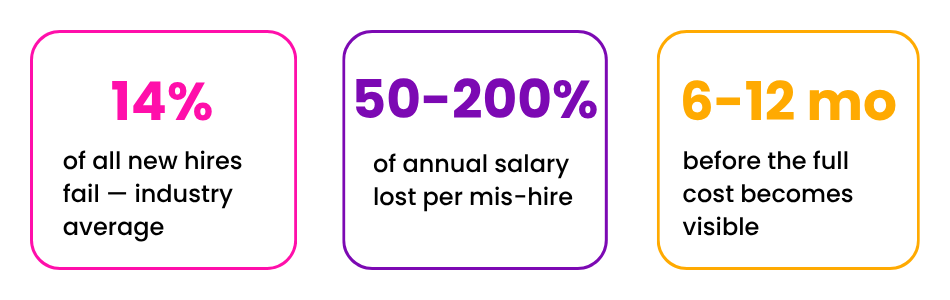
Around 14% of all new hires fail. Most companies are aware of this. Far fewer know what it is actually costing them, or where the money is quietly leaking away.
Most finance directors have never seen this number on a spreadsheet. It does not appear in the quarterly report or the cost-per-hire metric. And it is unlikely to be on the agenda for your next board meeting.
It is the true cost of your last bad hire.
Not the recruitment fee. Not the onboarding expense. The full cost – salary paid during underperformance, team productivity lost to compensation, manager time absorbed by damage control, and the cultural erosion that follows when the wrong person remains in the wrong role for six months too long.
Industry research puts this figure at between 50% and 200% of annual salary. For a €60,000 role, that is between €30,000 and €120,000. Per hire. Per mistake.
“Managers are hired for their professional qualifications — and fired for their personality.”
Oxford Economics / HR Morning
The uncomfortable truth is that most hiring processes are designed to catch the first kind of problem and are almost entirely blind to the second.
The iceberg nobody talks about
The direct costs of a bad hire are real but relatively straightforward to calculate: recruitment expenditure, onboarding investment, months of salary during the notice period, and the cost of restarting the process. For a mid-level role, these direct costs alone routinely exceed €50,000.
However, these are just the tip of the iceberg. What lies beneath the surface is much larger – and far more damaging.
By the time a mis-hire becomes undeniable, six to twelve months have usually passed. During this period, the team has been compensating. Colleagues work longer hours, take on responsibilities that were never theirs, and grow quietly resentful. Stress levels rise, quality declines, and the risk of a domino effect – where your best people start looking elsewhere because they are tired of carrying the load – increases with every week the problem remains unaddressed.
The research is clear: high turnover creates a contagion effect. When one person leaves, the probability that others will follow increases significantly. A single mis-hire in a team of eight is not just a personnel problem; it is a structural risk.
“Bad hires are like a slow leak in the system. That is exactly why they often go unaddressed for so long.”
Calculate your real exposure
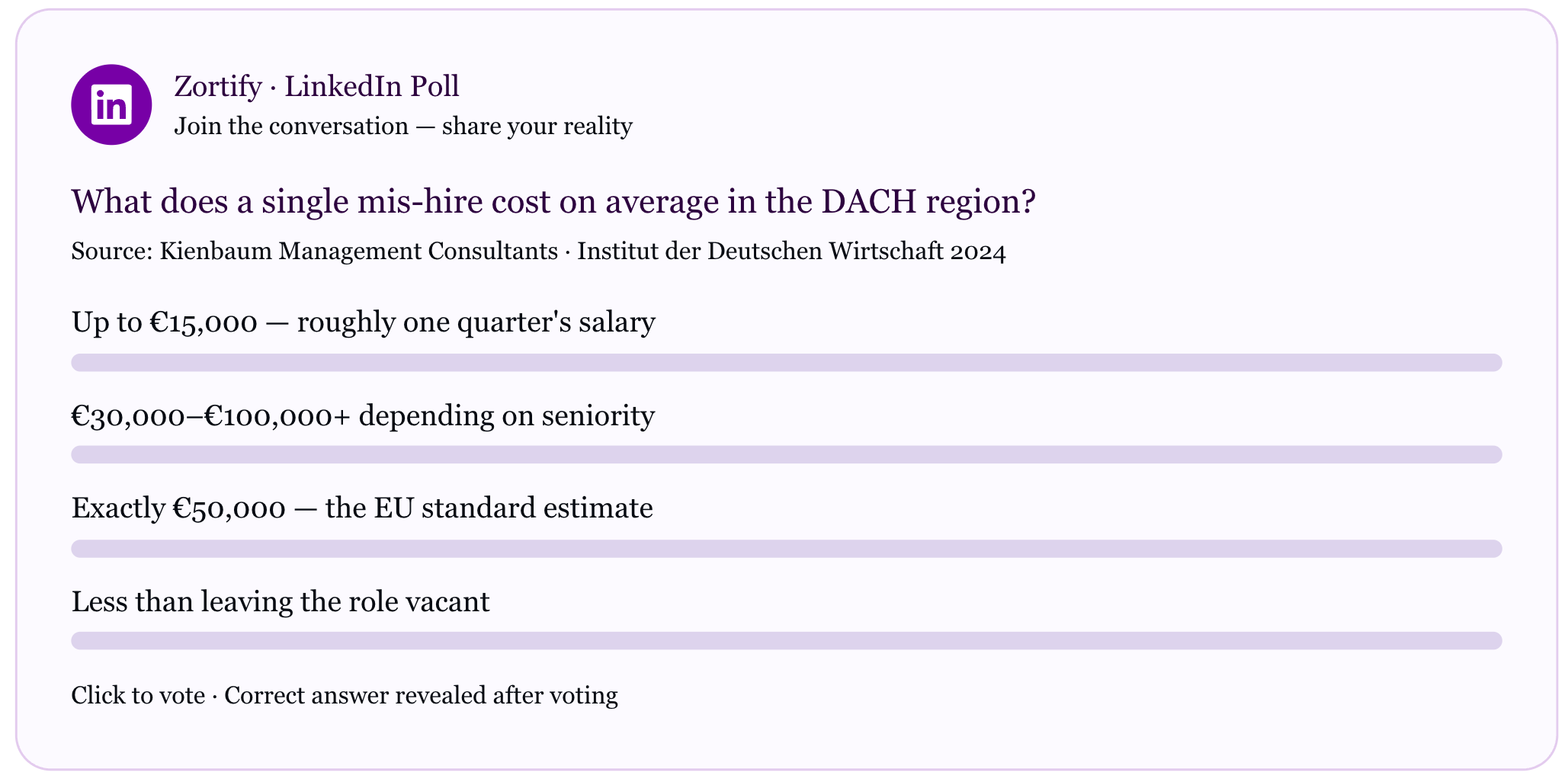
Before companies can solve a problem, they need to see it clearly. The calculator below takes three inputs – annual hires, average salary, and your estimated mis-hire rate – and shows you the financial exposure you are carrying right now, and what a more precise hiring process could save you.
Why companies keep spending money on the wrong things
Here is a paradox that most HR leaders recognise immediately: companies invest heavily in sourcing – job boards, agencies, LinkedIn – and comparatively little in the decision that actually determines whether the investment pays off.
The average cost per hire in Europe is around €4,700 (SHRM, 2022). The average cost of a bad hire is between €30,000 and €120,000. The spend ratio is inverted. Companies are over-investing in finding candidates and under-investing in selecting the right ones. This is not irrational; it is a visibility problem. Sourcing costs appear on invoices. Mis-hire costs are hidden in spreadsheets that nobody reads – spread across payroll, productivity metrics, manager time, and team health surveys that are rarely linked back to a hiring decision made nine months earlier.
The moment you make the invisible visible – as the calculator above does – the case for better selection becomes obvious. Not as an HR initiative, but as a capital allocation decision.
What better actually looks like
Improving hiring quality does not mean adding more interview rounds. Research consistently shows that additional unstructured interviews do not improve prediction accuracy; they primarily increase the cost and duration of the process while amplifying existing biases.
What improves outcomes is adding structured behavioural data at the right point in the process. Specifically, a personality assessment that goes beyond self-reported questionnaires to examine how a candidate actually thinks, communicates, and handles pressure.
Zortify's AI-based diagnostics – combining Natural Language Processing with validated Big Five, Entrepreneurial capital and Counterproductive behavioral tendencies psychometrics – fit naturally in the recruiting process and before the final decision. The output provides hiring managers with something they have rarely had before: an objective profile showing personality, working style, risk indicators, and entrepreneurial potential in a format clear enough to use in a debrief.
FROM OUR CLIENTS
Salonkee — 30% reduction in employee turnover after integrating Zortify into their recruitment process.
Crafts Unfolded — 33% reduction in time-to-hire. 100% culture-fit score across all assessed hires.
Saint Sass — 5 top talents hired in 4 weeks — 50% faster and up to 90% cheaper than the previous process.
The question every CFO should be asking HR
Finance tracks capital allocation precision. Operations tracks defect rates. If recruitment is the function that determines whether every other function has the right people to do their work, then recruitment must track decision accuracy.
Not time-to-fill. Not cost-per-hire. Decision accuracy – measured by quality of hire, first-year retention, and time-to-full-productivity.
These are the metrics that translate a hiring decision into a financial statement line. They are also the metrics that make the ROI of better selection tools undeniable.
A mis-hire is not the problem; it is a symptom. The real problem is treating hiring as a process to be completed, rather than a decision to be made well. The cost of that confusion – as the calculator above will show – is almost certainly greater than any other item on your HR budget.
See what better hiring looks like for your team.
Book a free 30-minute demo. We will run the numbers with you.
Sources: SHRM (2025); Gallup Workplace Report; Oxford Economics / HR Morning; U.S. Department of Labor; Celayix 2026
Prof. Dr. Florian Feltes
Prof. Dr. Florian Feltes is co-founder and co-CEO of zortify and a forerunner in AI-supported HR innovation. Together with his team, he develops intelligent personality diagnostics and helps companies identify the perfect candidates—without expensive assessments and without bias. His vision: a world in which every company can effortlessly form high-performance teams and create work environments that allow human potential to flourish.


Beyond AI Support: Why HR Must Become a Decision Architect

When someone leaves too soon – A Hiring Manager’s Perspective