The World Cup does not reward the best players

What 48 national squads, months of preparation, and decades of sports science can teach every organisation about building a team that truly performs.
The 2026 FIFA World Cup kicks off this week – the first edition to feature 48 teams, spread across the United States, Canada, and Mexico. It is the largest football tournament in history. As with every previous World Cup, the team that lifts the trophy will almost certainly not be the one with the most individually talented players on its roster.
Despite having Zinedine Zidane, France did not win in 2002. Despite having Cristiano Ronaldo, Portugal did not win in 2016. Argentina had to wait until 2022—forty years after their previous title – before the pieces around Messi finally came together. Individual brilliance is necessary but not sufficient. The difference between a squad of stars and a high-performance team is something deeper, and organisations outside football have struggled to build it for decades.
So what do national teams actually do in the months before a World Cup to create something that works? And what does it look like when it does?
What a national team actually has to build
Each team at this World Cup can name up to 26 players, including three goalkeepers. Those 26 players come from different clubs, different leagues, sometimes different countries, different cultures, different playing styles, and different conceptions of their own roles. They have spent the season competing against each other. They have approximately two weeks together before the first match.
The challenge is not talent; the challenge is cohesion – building, in a compressed timeframe, the shared understanding, trust, and role clarity that club teams develop over months and years.
The 2026 FIFA World Cup will test not only teams’ tactical systems and physical preparation but also the maturity of their science ecosystems – with interdisciplinary collaboration evident from squad selection to player load management across up to eight matches. The environmental conditions – distances between cities, climate, travel schedules – add pressure for which no club season prepares players. Success, researchers note, depends on how effectively players transform uncertainty into opportunity, and variability into a source of resilience and creativity on the pitch.
That is a sentence that applies equally well in a boardroom.
The science of squad selection – it is not just about the best players
Watch closely when a national coach names their squad and you will notice something: the best player in a given position does not always make the cut. Form matters. Fitness matters. But so does something harder to quantify – how a player fits into the specific dynamic the coach is trying to build.
Brazil, for example, are trying to build a team around the speed, technique, and intelligent movement of their attacking players – not a traditional striker – supported by a strong midfield duo driven by Casemiro’s leadership.
That is not just a tactical choice; it is a team design decision: which combination of roles, personalities, and working styles produces the best collective output?
“You have to boost each other up and support each other, especially when things are not going well.”
Sport psychology research – Bryant University, 2026
The use of positive language is crucial, both internally and aloud. While individual players need to develop internal skills to recover from setbacks and avoid spiralling, teammates should also offer encouragement in these moments. The psychological infrastructure of a team – how members communicate under pressure, respond to setbacks, and distribute leadership – is as carefully designed as the tactical formation.
What the preparation actually looks like
The months before a World Cup are not just about physical preparation; they are about team construction. Here is what the best national programmes do – and how this maps onto an organisational context:
Every player knows not just their position but their function within the team’s system. Coaches spend weeks defining who does what, when, and why — before the squad ever steps on a pitch together. Ambiguity about roles is the single fastest way to destroy team cohesion.
The best squads create environments where players can acknowledge mistakes, ask for help, and disagree with the coach without fear. Research consistently shows this is the highest predictor of team performance — in sport and in organisations.
No successful team is built from one personality type. You need the creative disruptor and the disciplined executor. The vocal leader and the quiet anchor. The risk-taker and the risk-manager. Complementarity is the point.
Teams that win World Cups are not the ones that don’t concede goals. They are the ones that concede and recover. Collective resilience — the ability to absorb pressure and continue functioning — is built intentionally, not hoped for.
Modern football uses more performance data than at any point in history. But the best coaches use data to inform human decisions — not replace them. The insight is only valuable if the person interpreting it understands both the numbers and the people.
The numbers that make this a business conversation
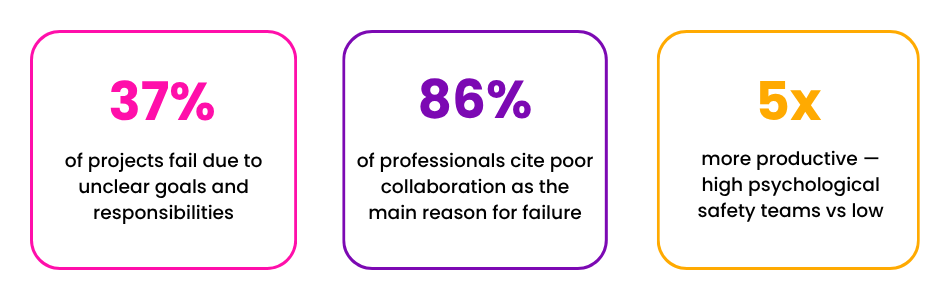
These are not football statistics; they are from Project Management Institute research and Fierce Inc. workplace studies. The dynamics that determine whether a national team wins a World Cup are structurally identical to those that determine whether a product team ships on time, whether a sales team meets its targets, or whether a leadership team survives a reorganisation.
The difference is that football coaches take these dynamics seriously enough to measure, design for, and invest in them before the tournament begins. Most organisations wait until something breaks.
What makes a team a team – the six roles
In football, every position on the pitch serves a distinct function – and no team wins with eleven strikers. The same logic applies in organisations. Research behind ZortifyTeam identifies six fundamental work roles that every high-performing team needs:
Sets direction, maintains momentum, pushes for outcomes
Generates ideas, challenges assumptions, sees new angles
Builds relationships, reads the room, holds the team together
Creates structure, tracks detail, ensures follow-through
Evaluates critically, identifies risk, slows down good decisions
Grows people, mentors, invests in long-term capability
Every great football squad has players who naturally fill each of these roles – the creative midfielder, the defensive anchor, the vocal organiser, the quiet influencer. When a coach selects their squad, they are not simply choosing the best twenty-six players. They are designing a system of complementary roles.
Most organisations assemble teams by function and seniority. The question of whether the combination of personalities and working styles actually produces collective intelligence – or collective friction – is rarely asked until it becomes evident in the results.
What this World Cup will actually test
The 2026 World Cup’s vast distances between cities and increased number of knockout games will create conditions teams have never encountered before. The teams that navigate this best will not necessarily be the most talented. They will be the most cohesive – those who have built trust, role clarity, and collective resilience to perform well under conditions they did not fully anticipate.
That is the test. And it is the same test your organisation faces every quarter.
The best team does not win. The best-built team does.
ZORTIFYTEAM
Discover which roles your team is missing
ZortifyTeam maps the six fundamental work roles across your team – showing you where you have complementarity, where you have gaps, and what to do about it.
Prof. Dr. Florian Feltes
Prof. Dr. Florian Feltes is co-founder and co-CEO of zortify and a forerunner in AI-supported HR innovation. Together with his team, he develops intelligent personality diagnostics and helps companies identify the perfect candidates—without expensive assessments and without bias. His vision: a world in which every company can effortlessly form high-performance teams and create work environments that allow human potential to flourish.


Amazon enters recruiting. Should HR be impressed or concerned?

The Sales Gene – does it actually exist?