The new recruiting paradox

Recruiting has entered a paradox.
On one hand, organisations are overwhelmed by an unprecedented volume of applications. On the other, hiring managers still struggle to find candidates who truly match the role.
For HR leaders and decision-makers, this creates a costly ambiguity: more candidates to review, but less certainty about who will actually succeed in the role.
This article explores why this paradox is emerging – and how organisations can adapt their hiring strategies to make faster and more reliable decisions.
The application flood: when AI multiplies candidate volume
Generative AI has dramatically lowered the barrier to applying for jobs.
Candidates can now generate tailored CVs and cover letters in seconds and apply to dozens – sometimes hundreds – of positions automatically. As a result, application volumes have surged across industries.
Recent data illustrates the scale of the shift:
- Job applications on major platforms have increased by more than 45% in the past year, with roughly 11,000 applications submitted every minute globally.
- 46% of CVs are now generated or significantly assisted by AI tools such as ChatGPT or Gemini.
- 62% of recruiters report that most applications they receive are not qualified for the role.
What used to be a scarcity problem – not enough candidates – is increasingly becoming a signal-to-noise problem.
For HR teams, this means:
- More CVs to review
- Less differentiation between applicants
- More time spent verifying authenticity
In short, volume has increased, but informational value has decreased.
At the same time, the talent shortage has not disappeared.
Paradoxically, the surge in applications does not mean that organisations suddenly have access to more qualified talent.
Across industries, companies still report significant skill shortages, particularly for leadership roles, technical expertise, and complex knowledge work.
Structural factors driving this scarcity include:
- demographic shifts and shrinking workforces in many developed economies,
- rapidly evolving skill requirements,
- growing demand for digital and AI-related capabilities.
In emerging fields, demand is increasing faster than the supply of talent. For example, research on labour market trends shows that demand for AI-related roles has grown significantly in recent years, while qualified professionals remain scarce.
The result is dual pressure on recruitment teams:
- Too many applications to process
- Too few truly qualified candidates
This paradox creates a hidden operational risk.
The real business risk: expensive hiring mistakes
When signal quality declines, hiring decisions become more uncertain, increasing the likelihood of costly mis-hires. The financial consequences are substantial:
- Mis-hires can incur six-figure indirect costs when considering salary, lost productivity, team disruption, and replacement hiring.
- Poor leadership hires can destabilise projects, increase turnover, and damage client relationships.
In environments where candidates appear equally qualified on paper – a situation increasingly common with AI-generated applications – decision-making often shifts towards subjective impressions.
This is where the real risk arises.
Because, the more similar candidates seem at the application stage, the more decision quality relies on the depth and structure of the evaluation process.
Why traditional screening methods are reaching their limits
Traditionally, recruiters have relied on three main signals:
- CV experience
- Educational background
- Interview impressions
However, generative AI has undermined the reliability of the first two. AI-generated CVs can present highly polished narratives, making candidates appear more qualified than their actual experience indicates. Recruiters are increasingly faced with applications that look impressive but reveal little about genuine behavioral patterns or long-term performance potential.
At the same time, interviews alone are often insufficient to resolve this ambiguity.
Interview outcomes can vary widely depending on:
- the interviewer,
- the questions asked,
- unconscious bias,
- and the candidate’s level of preparation.
Without structured decision frameworks, hiring panels frequently end up debating perceptions rather than evidence.
A new standard: moving from Screening to Prediction
To navigate this new environment, many organisations are shifting their hiring strategy from simple screening to predictive evaluation.
Instead of asking only, “Does this candidate look qualified?” the more relevant question becomes, “Based on reliable signals, how likely is this candidate to succeed in this role?”
This is where predictive assessment and structured diagnostics are gaining importance. Research shows that AI-supported recruitment tools can improve hiring accuracy by up to 40% and increase candidate matching quality by 67% when used appropriately within the decision process.
However, technology alone is not the solution.
The real value emerges when predictive insights are integrated into a structured decision logic that hiring managers can use consistently.
Turning data into better hiring decisions
Forward-looking organisations are therefore introducing an additional layer of diagnostic insight into their hiring process. Platforms such as Zortify take this approach by combining validated psychometric measurement with AI-supported analysis of open-text responses.
Rather than replacing interviews, this creates a structured evaluation framework that provides decision-makers with insights into:
- personality structure
- resilience and entrepreneurial mindset
- cultural alignment
- potential counterproductive tendencies
These insights serve as evidence-based signals that help hiring managers move beyond CV narratives and interview impressions.
The goal is not to automate decisions, but to enable better-informed decisions.
When predictive diagnostics are integrated early in the process, interviews become more focused, comparisons between candidates become more transparent, and discussions within hiring panels shift from opinion to evidence.
The future of recruiting: clarity in a noisy market
The recruiting landscape will likely remain complex.
Generative AI will continue to increase application volume, while demographic and economic factors will sustain pressure on talent supply. This presents HR leaders with a structural challenge: how to identify real potential in a market full of polished but increasingly similar applications.
Organisations that succeed will not necessarily be those with the fastest hiring processes, but those with the clearest decision standards – standards that allow hiring managers to distinguish between candidates who look strong on paper and those most likely to perform and grow in the role.
In an environment where both candidates and companies use AI, the competitive advantage will belong to organisations that combine human judgement with reliable predictive insights.
In the end, the real goal of recruiting has not changed: not hiring faster, but hiring right.
Prof. Dr. Florian Feltes
Prof. Dr. Florian Feltes is co-founder and co-CEO of zortify and a forerunner in AI-supported HR innovation. Together with his team, he develops intelligent personality diagnostics and helps companies identify the perfect candidates—without expensive assessments and without bias. His vision: a world in which every company can effortlessly form high-performance teams and create work environments that allow human potential to flourish.


Budget killer bad hires
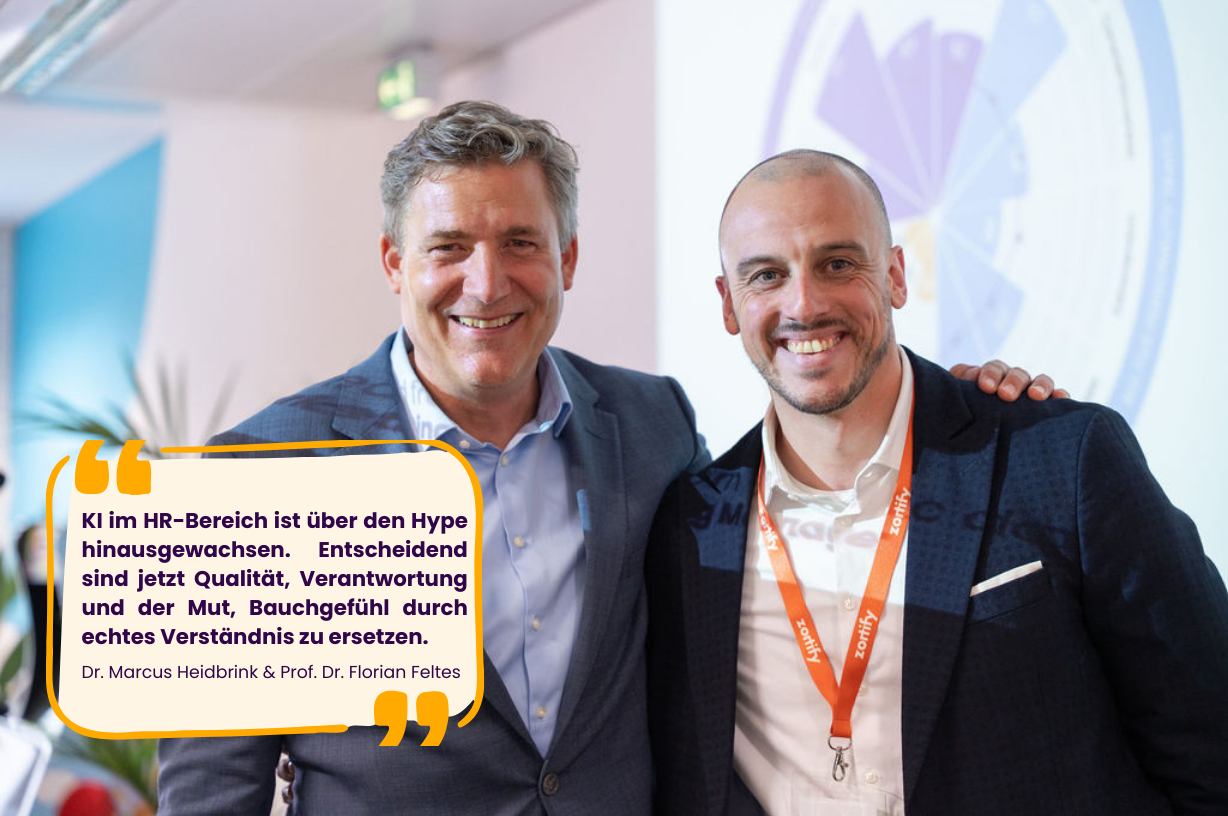
2025 Check-Out with Marcus & Florian, CEOs of Zortify