The hire who did not stay

The notification arrives on a Tuesday morning. The hiring manager wants to talk. You already sense the reason before the call connects. The person you placed four months ago has resigned.
You review the process in your mind: sourcing, screening, interviews, offer. Everything went smoothly. They were qualified. They were enthusiastic. You felt confident about the match. Now you are back to the beginning – except it does not feel like a fresh start. It feels like a setback.
This is the aspect of recruiting that is rarely discussed.
A profession under pressure – before the call even comes
To understand why early turnover affects recruiters differently, it is important to consider the conditions they already face.
54% of recruiters report that their job has become more stressful in recent years. The burnout rate among recruiters reached 81% in 2024. They are managing time-to-fill targets, hiring manager expectations, candidate experience, and the constant pressure to move quickly without making costly mistakes – often all at once.
According to the Recruiter Nation Report, 44% of talent acquisition professionals cite competitive pressure as a primary source of stress. And that is before a hire leaves early.
When someone resigns within the first year, the pressure does not disappear; it compounds. There is self-doubt – did I overlook something? There is defensiveness – the process was thorough. And sometimes, quietly, there is a shift: towards safer choices, towards candidates who look good on paper rather than those who genuinely fit. That shift, over time, makes the problem worse.
What the data is actually telling us
Between 38% and 52% of all employee turnover occurs within the first twelve months. 20% happens within the first 45 days. Early attrition peaks at the 12-month mark – just when the investment in onboarding and ramp-up has been made, but before full productivity has been achieved.
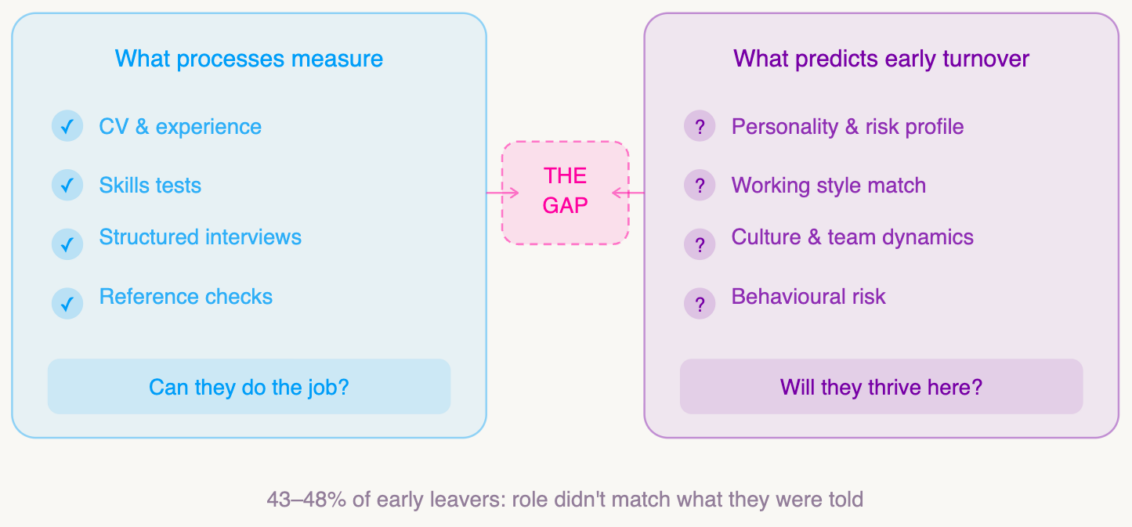
The most cited reasons are misaligned expectations (43–48% of early leavers say the role did not match what they were told), poor onboarding, lack of development, and cultural mismatch.
Notice what is largely absent from that list: skills. The person often could do the job. The problem was everything surrounding the job – how it was presented, what the environment actually felt like, whether the person’s personality genuinely suited the demands of the role and the dynamics of the team.
That is a fit problem. And fit is harder to assess than qualifications.
The accountability gap nobody discusses
This is particularly challenging for recruiters: quality of hire is increasingly tracked as a formal KPI, yet the tools to measure fit before hiring are rarely provided.
Companies now use first-year attrition as a direct measure of recruitment effectiveness. Recruiters are evaluated on whether their hires stay and perform, yet most are still left to assess personality, culture fit, and behavioural risk using intuition, body language, and a gut feeling formed in forty-five minutes.
It is not that recruiters lack perception; rather, the tools simply do not match the questions they are expected to answer.
Poor hires who are not a good fit for the role lead to higher attrition rates, damage to employer brand, and a perpetuating cycle of sourcing and re-hiring. The recruiter bears a disproportionate share of that reputational burden – internally with hiring managers, and externally with candidates who encounter an organisation unable to retain its people.
Unconscious bias: the hidden variable
Without structured behavioural data, recruiters – like all humans – tend to favour candidates who feel familiar, those who mirror their communication style, energy, or background. We call it chemistry. Sometimes it is; often, it is a blind spot.
Research consistently confirms this. Unstructured interviews are among the weakest predictors of job performance, yet they remain the dominant hiring method. The result is not just a higher risk of mis-hire – it is a systematically skewed talent pool, where decisions are influenced more by similarity than by suitability.
For recruiters who care about both quality and equity, this is a genuine professional frustration. They know something is missing; they just do not always have the means to fill the gap.
A better starting point
What would it look like to enter every interview with actual personality data in hand?
Not as a replacement for the conversation, but as a foundation for it. An objective profile that shows how a candidate tends to handle pressure and ambiguity, how they communicate and collaborate, where their risk tendencies lie, and how their working style aligns with the realities of the role.
This is what AI-based personality assessment makes possible. At Zortify, we have built exactly this kind of tool – designed to fit naturally after the first interview, giving recruiters and hiring managers a consistent behavioural layer across every role. One framework. One shared language. Insights clear enough to use in a debrief.
The result is not just fewer early departures. It is a different kind of conversation during the process – one that identifies fit before it becomes an issue. For recruiters, it offers something equally valuable: a defensible, data-backed basis for every recommendation they make.
The hire who stays
The best outcome in recruitment is not simply filling a position. It is hiring someone who, after six months, is developing – someone the team is pleased to have, and who cannot imagine being anywhere else.
That outcome is possible more often than current attrition rates suggest. However, it requires moving beyond the CV and first impressions. It means making personality a genuine, structured part of decision-making.
For recruiters, this is not just a process improvement. It is protection – for the candidate, for the team, and for the professional credibility that every good recruiter spends years building.
The hire who did not stay is a hard lesson. It does not have to be repeated.
Prof. Dr. Florian Feltes
Prof. Dr. Florian Feltes is co-founder and co-CEO of zortify and a forerunner in AI-supported HR innovation. Together with his team, he develops intelligent personality diagnostics and helps companies identify the perfect candidates—without expensive assessments and without bias. His vision: a world in which every company can effortlessly form high-performance teams and create work environments that allow human potential to flourish.


When someone leaves too soon – A Hiring Manager’s Perspective
The new recruiting paradox