Budget killer bad hires:

Around 14% of all new hires fail. With 50 hires per year, this can quickly add up to over $300,000 in direct costs. And that’s just the tip of the iceberg. The real damage become apparent later: declining team performance, lost innovation, and a domino effect that drives top performers to competition. Bad hires are like a slow leak in the system. That’s exactly why they often go unaddressed for a long time. It’s time to change that.
The domino effect: from the wrong hire to crisis
The obvious costs are clear: recruiting expenses, onboarding, months of salary, and a new hiring process. Studies estimate the replacement costs – depending on the role and seniority – at 50% to four times the annual salary.
But even these figures fall short. By the time a bad hire becomes apparent, six to twelve months have often already passed. During this time, the team has to compensate, for example by working longer hours and putting in more effort to coordinate. stress level rise, quality declines, and the risk of exhaustion and burnout increase structurally. The important thing to note is that the damage rarely affects just one person. Bad hires can trigger chain reactions that destabilize entire departments. At this point, at the latest, it becomes clear that is not a “soft” cultural issue, but rather the measurable business of hiring decisions.
Skills-first meets personality-first
Many organizations still focus too much on applicants’ professional qualifications and too little on what really make people successful in everyday life: ownership, integrity, resilience, learning ability, and collaboration. Oxford Economics sums it up succinctly: Managers are hired for their professional qualifications – and fired for their personality.
The solution is not either/or, but a smart combination:
- Skills-based to ensure the professional foundation,
- Personality-based to increase the likelihood of sustainable performance.
Important: It’s not about testing more, but about making better decisions. The key lies in the predictability of performance.
From gut feeling to measurable results
This is where this AI-supported diagnostics come in: they can significantly increase the quality of professional performance forecasts. Companies report 31% faster hiring times with AI tools, 50% better quality of hire, and with proper implementation – 50-61% less unconscious bias.
How personality-based recruiting works:
- NLP instead of multiple choice: AI analyzes open-ended text responses. The results are less socially desirable and closer to actual thinking and communication logic.
- Big 5 Model: Scientifically validated, the model measures business-critical characteristics like openness, conscientiousness, extraversion, agreeableness, and emotional stability.
- Entrepreneurial Capital: Analysis of urgently needed characteristics
in a rapidly changing environment, such as resilience, self-efficacy, optimism, and agility mindset. - Counterproductive Behavior Tendencies: Measurement of risk factors like
strategic manipulative beahvior and impulsivity. - Cultural fit: Comparison of personality with the values and working methods of the company
Instead of “it’ll do,” organizations receive data-based probabilities of success, enabling them to plan to plan team capacities and implement projects more reliably. The KPIs are clear: shorter time-to-fill, higher offer acceptance rate, better quality of hire, higher retention rate, and shorter time-to-productivity. The latter in particular is often underestimated: suitable employees become productive more quickly.
HR: From process owner to decision-making authority
When recruiting is understood as strategic value creation, the role of HR automatically changes. HR is then no longer the authority that coordinates appointements and guides process steps, but rather the function that sets the decision-making standard. This means that HR is not only responsible for ensuring that hiring takes place, but also that it is of high quality, i.e., transparent and business-relevant. HR ensures governance, fairness, and compliance without losing speed.
More stability, less rework, more leadership capacity
In the long term, this creates a system that not only fills positions faster, but also better. Fewer miscasts mean less friction, more stable teams, and more leadership capacity for value creation instead of damage control.
Companies that modernize their decision-making standards in 2026 will gain an advantage in a working world where adaptability, responsibility, and cultural fit determine competitiveness.
Download the whitepaper “The business impact of fast and precise recruiting decisions”
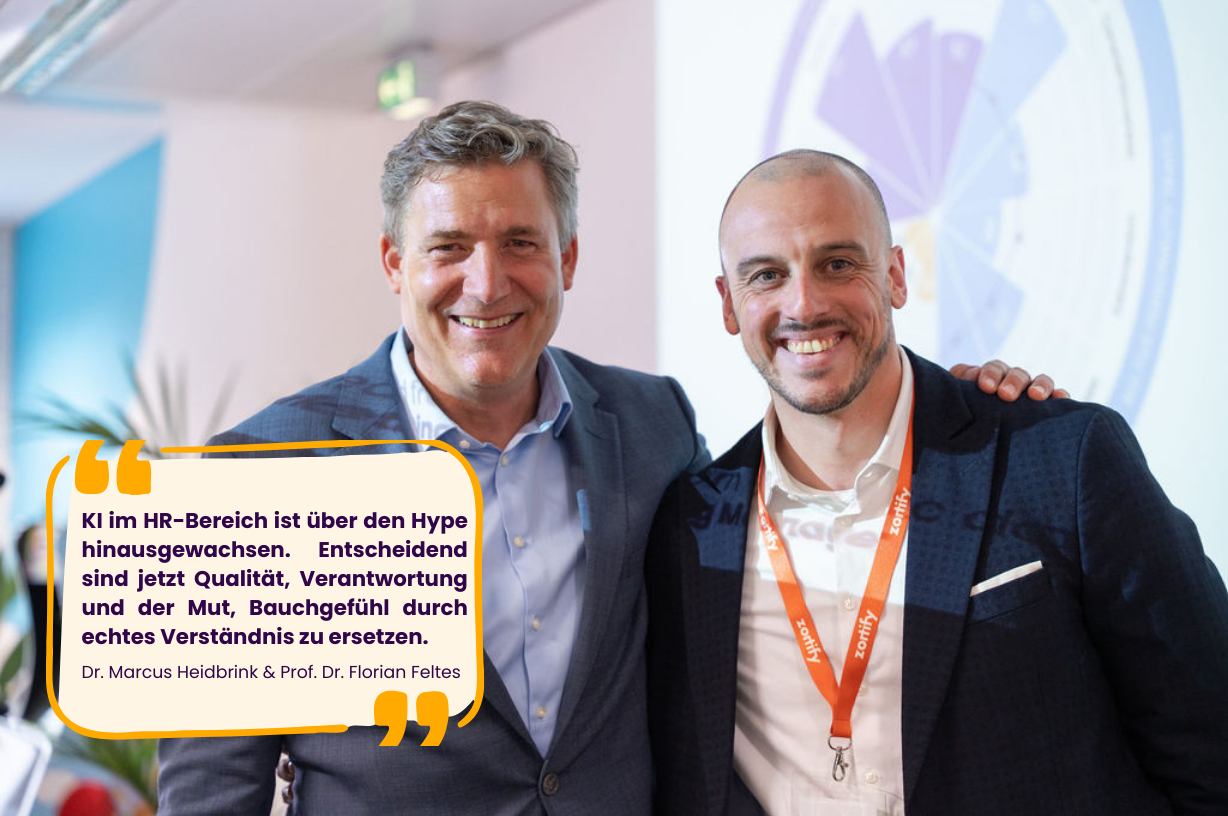
Prof. Dr. Florian Feltes
Prof. Dr. Florian Feltes is co-founder and co-CEO of zortify and a forerunner in AI-supported HR innovation. Together with his team, he develops intelligent personality diagnostics and helps companies identify the perfect candidates—without expensive assessments and without bias. His vision: a world in which every company can effortlessly form high-performance teams and create work environments that allow human potential to flourish.


1 in 700 is not enough! – How companies really hire based on skills
2025 Check-Out with Marcus & Florian, CEOs of Zortify