What 48 national squads, months of preparation, and decades of sports science can teach every organisation about building a team that truly performs.
The 2026 FIFA World Cup kicks off this week – the first edition to feature 48 teams, spread across the United States, Canada, and Mexico. It is the largest football tournament in history. As with every previous World Cup, the team that lifts the trophy will almost certainly not be the one with the most individually talented players on its roster.
Despite having Zinedine Zidane, France did not win in 2002. Despite having Cristiano Ronaldo, Portugal did not win in 2016. Argentina had to wait until 2022—forty years after their previous title – before the pieces around Messi finally came together. Individual brilliance is necessary but not sufficient. The difference between a squad of stars and a high-performance team is something deeper, and organisations outside football have struggled to build it for decades.
So what do national teams actually do in the months before a World Cup to create something that works? And what does it look like when it does?
What a national team actually has to build
Each team at this World Cup can name up to 26 players, including three goalkeepers. Those 26 players come from different clubs, different leagues, sometimes different countries, different cultures, different playing styles, and different conceptions of their own roles. They have spent the season competing against each other. They have approximately two weeks together before the first match.
The challenge is not talent; the challenge is cohesion – building, in a compressed timeframe, the shared understanding, trust, and role clarity that club teams develop over months and years.
The 2026 FIFA World Cup will test not only teams’ tactical systems and physical preparation but also the maturity of their science ecosystems – with interdisciplinary collaboration evident from squad selection to player load management across up to eight matches. The environmental conditions – distances between cities, climate, travel schedules – add pressure for which no club season prepares players. Success, researchers note, depends on how effectively players transform uncertainty into opportunity, and variability into a source of resilience and creativity on the pitch.
That is a sentence that applies equally well in a boardroom.
The science of squad selection – it is not just about the best players
Watch closely when a national coach names their squad and you will notice something: the best player in a given position does not always make the cut. Form matters. Fitness matters. But so does something harder to quantify – how a player fits into the specific dynamic the coach is trying to build.
That is not just a tactical choice; it is a team design decision: which combination of roles, personalities, and working styles produces the best collective output?
“You have to boost each other up and support each other, especially when things are not going well.”
The use of positive language is crucial, both internally and aloud. While individual players need to develop internal skills to recover from setbacks and avoid spiralling, teammates should also offer encouragement in these moments. The psychological infrastructure of a team – how members communicate under pressure, respond to setbacks, and distribute leadership – is as carefully designed as the tactical formation.
What the preparation actually looks like
The months before a World Cup are not just about physical preparation; they are about team construction. Here is what the best national programmes do – and how this maps onto an organisational context:
01Role clarity before chemistry
Every player knows not just their position but their function within the team’s system. Coaches spend weeks defining who does what, when, and why — before the squad ever steps on a pitch together. Ambiguity about roles is the single fastest way to destroy team cohesion.
02Psychological safety as a design principle
The best squads create environments where players can acknowledge mistakes, ask for help, and disagree with the coach without fear. Research consistently shows this is the highest predictor of team performance — in sport and in organisations.
03Diverse profiles, not clones
No successful team is built from one personality type. You need the creative disruptor and the disciplined executor. The vocal leader and the quiet anchor. The risk-taker and the risk-manager. Complementarity is the point.
04Resilience as a collective capacity
Teams that win World Cups are not the ones that don’t concede goals. They are the ones that concede and recover. Collective resilience — the ability to absorb pressure and continue functioning — is built intentionally, not hoped for.
05Data-informed, human-led
Modern football uses more performance data than at any point in history. But the best coaches use data to inform human decisions — not replace them. The insight is only valuable if the person interpreting it understands both the numbers and the people.
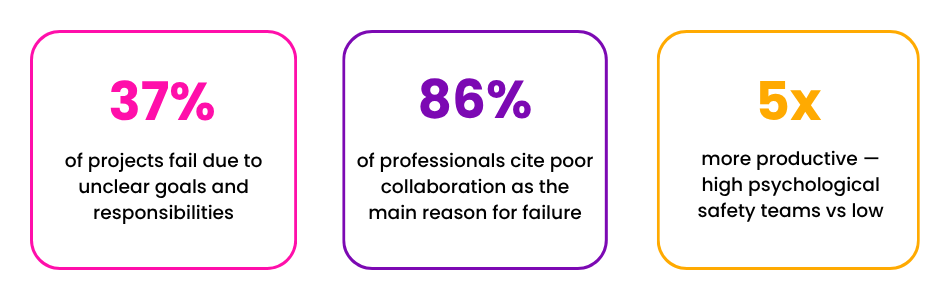
The numbers that make this a business conversation
These are not football statistics; they are from Project Management Institute research and Fierce Inc. workplace studies. The dynamics that determine whether a national team wins a World Cup are structurally identical to those that determine whether a product team ships on time, whether a sales team meets its targets, or whether a leadership team survives a reorganisation.
The difference is that football coaches take these dynamics seriously enough to measure, design for, and invest in them before the tournament begins. Most organisations wait until something breaks.
What makes a team a team – the six roles
In football, every position on the pitch serves a distinct function – and no team wins with eleven strikers. The same logic applies in organisations. Research behind ZortifyTeam identifies six fundamental work roles that every high-performing team needs:
🎯
The Driver
Sets direction, maintains momentum, pushes for outcomes
💡
The Creator
Generates ideas, challenges assumptions, sees new angles
🤝
The Connector
Builds relationships, reads the room, holds the team together
Evaluates critically, identifies risk, slows down good decisions
🌱
The Developer
Grows people, mentors, invests in long-term capability
Every great football squad has players who naturally fill each of these roles – the creative midfielder, the defensive anchor, the vocal organiser, the quiet influencer. When a coach selects their squad, they are not simply choosing the best twenty-six players. They are designing a system of complementary roles.
Most organisations assemble teams by function and seniority. The question of whether the combination of personalities and working styles actually produces collective intelligence – or collective friction – is rarely asked until it becomes evident in the results.
What this World Cup will actually test
The 2026 World Cup’s vast distances between cities and increased number of knockout games will create conditions teams have never encountered before. The teams that navigate this best will not necessarily be the most talented. They will be the most cohesive – those who have built trust, role clarity, and collective resilience to perform well under conditions they did not fully anticipate.
That is the test. And it is the same test your organisation faces every quarter.
The best team does not win. The best-built team does.
ZORTIFYTEAM
Discover which roles your team is missing
ZortifyTeam maps the six fundamental work roles across your team – showing you where you have complementarity, where you have gaps, and what to do about it.
Prof. Dr. Florian Feltes is co-founder and co-CEO of zortify and a forerunner in AI-supported HR innovation. Together with his team, he develops intelligent personality diagnostics and helps companies identify the perfect candidates—without expensive assessments and without bias. His vision: a world in which every company can effortlessly form high-performance teams and create work environments that allow human potential to flourish.
You may also like
Amazon enters recruiting. Should HR be impressed or concerned?
Amazon Connect Talent has just launched. It can conduct AI voice interviews around the clock, score every candidate, and provide recruiters with a dashboard of results. Here is what it actually means for HR – and what it gets dangerously wrong.
We have been hiring salespeople incorrectly for decades. Not because we lack talent, but because we have been searching for the wrong qualities. Imagine the salesperson you would hire tomorrow. You probably already have an image in mind: confident, charismatic, outgoing, quick-witted. Someone who lights up a room and turns strangers into customers before the coffee goes cold.
The mis-hire is not the problem. Not knowing what it costs you is.
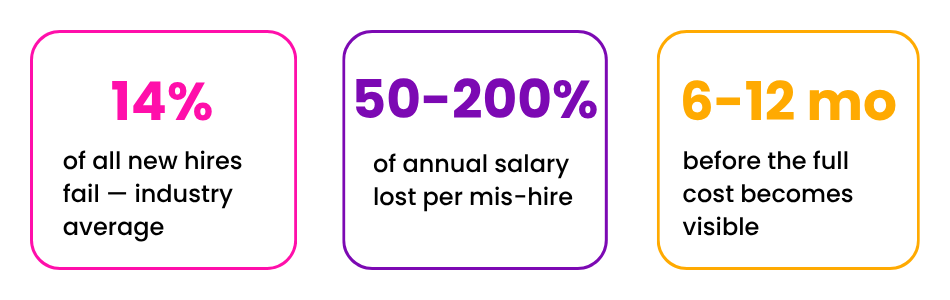
Around 14% of all new hires fail. Most companies are aware of this. Far fewer know what it is actually costing them, or where the money is quietly leaking away. Most finance directors have never seen this number on a spreadsheet. It does not appear in the quarterly report or the cost-per-hire metric. And it is unlikely to be on the agenda for your next board meeting.
Amazon Connect Talent has just launched. It can conduct AI voice interviews around the clock, score every candidate, and provide recruiters with a dashboard of results. Here is what it actually means for HR – and what it gets dangerously wrong.
Amazon does not enter markets quietly. When AWS announced Connect Talent in April 2026—an agentic AI platform that conducts structured voice interviews, scores candidates, and delivers hiring recommendations without human involvement – it sent a clear signal: AI is no longer merely assisting recruiters; it is replacing parts of the process entirely.
The headlines were predictably enthusiastic. The product is technically impressive. However, before HR leaders rush to adopt it, there are questions worth asking – about what it actually measures, what it overlooks, whether it is legal to use in Europe, and whether Amazon is truly the hiring role model anyone wants to follow.
What Amazon Connect Talent actually does
Amazon Connect Talent uses AI agents to conduct structured voice interviews, administer science-backed assessments, and score candidates consistently, allowing recruiters to focus on strategic decisions. Candidates can interview 24/7 from any device. The platform includes adaptive questioning, a mobile-first candidate portal, ATS integrations, and a recruiter dashboard with transcripts and evaluations.
Starting with an existing job description, AI agents analyse the role requirements and generate a complete interview plan – identifying key competencies, creating structured questions, and building evaluation criteria. Once approved, the system automatically invites candidates to interview at their convenience.
Informed by decades of Amazon’s hiring science, Amazon Connect Talent provides transparency for every assessment, interview, and candidate score, enabling recruiters to retain control over final hiring decisions. During the preview, the platform supports English, Portuguese, French, Italian, German, and Spanish.
On paper, it sounds compelling, particularly for high-volume hiring environments. AWS is explicit that the target is high-volume hiring: seasonal retail, logistics, healthcare staffing, and hospitality. Amazon hired approximately 250,000 seasonal workers in 2025. The product is, in some sense, Amazon packaging its own peak-season playbook.
For talent acquisition leaders managing hundreds of open roles, the efficiency argument is compelling. Scheduling alone consumes enormous recruiter bandwidth. A system that conducts interviews around the clock, reduces time-to-hire, and delivers consistent scoring across all candidates addresses genuine pain points.
However, efficiency is not the same as quality. Speed is not the same as fit. The most expensive hiring mistake is not the slow hire – it is the fast hire who leaves after six months.
“
“It’s very powerful, because if you’re recruiting for a high-turnover role — like a truck driver, warehouse worker, any sort of tactical work — you’re going to get a lot of applicants and need time to schedule interviews. Hiring managers don’t have a lot of time to do it, either. So, it serves as a very good screening tool… it’s a way to take all of the intellectual property that companies use for interviewing and embed it in a much more scalable experience.”
Bersin’s framing is telling: the use case is high-volume, high-turnover hiring. This raises a fundamental question for white-collar HR leaders – is that the problem you are trying to solve?
The dangers nobody is discussing
Amazon’s own track record
⚠️
The 2014–2018 AI failure
In 2014, Amazon’s engineers started building an internal AI recruiting tool. By 2018, Reuters reported the company had quietly scrapped it after discovering it had taught itself to penalise resumes containing the word “women’s,” downgraded graduates of certain women’s colleges, and favoured verbs statistically more common on male engineers’ resumes. Connect Talent claims to have solved this. The burden of proof is on them.
The regulation’s extra-territorial reach mirrors the GDPR. Any organisation, regardless of location, must comply if its AI systems are used within the EU or produce outputs that affect EU residents. A US-based company using AI for hiring that serves European customers falls within scope, even if the AI models run on servers outside Europe.
What does this mean in practice? Under the EU AI Act, AI systems used for employment screening are classified as high-risk. They require human oversight mechanisms, transparent documentation, bias auditing, explainability of outputs, and a Fundamental Rights Impact Assessment before deployment.
Amazon signed the GPAI Code of Practice in August 2025, alongside Microsoft, Google, OpenAI, and Anthropic. This is a transparency commitment for general-purpose AI models. It is not equivalent to the EU AI Act conformity assessment required for a high-risk employment screening system. These are distinct obligations, and Connect Talent currently offers no published conformity documentation for European deployment.
In summary, Connect Talent is currently in preview, built primarily for the US market, and carries significant legal uncertainty for European deployment.
Is this really something we want?
Beyond the legal question lies a question of values, and it is worth considering that seriously.
A hiring process reflects on an organisation. For most people, the candidate experience is their first genuine encounter with your company’s culture. A fully automated voice interview, conducted by AI at 11 pm with no human present, sends a clear message. Whether that message aligns with what your employer brand intends to communicate is a question only you can answer.
For high-volume commodity hiring, the trade-off may be acceptable. For white-collar roles, leadership positions, or teams where culture fit and personality alignment determine whether someone stays and thrives, automating the human element out of the first conversation is a choice with consequences.
The best outcome in hiring is not a faster decision, but a better one.
Why Zortify is a better choice for European HR teams
Amazon Connect Talent
Zortify
What it measures
Competency responses in structured voice interviews
Validated personality profile: Big Five, Entrepreneurial Capital, risk indicators
White-collar roles where personality fit predicts performance and retention
The fundamental difference is not speed or scale, but what is measured and what that measurement actually predicts.
Amazon Connect Talent can tell you, more quickly and consistently, how a candidate performs in a structured competency interview. That is useful. However, it cannot tell you whether that person has the self-efficacy to handle ten rejections in a row, the resilience to recover from a setback, the conscientiousness to follow regulatory requirements without supervision, or the risk profile that could make them a liability in a leadership role.
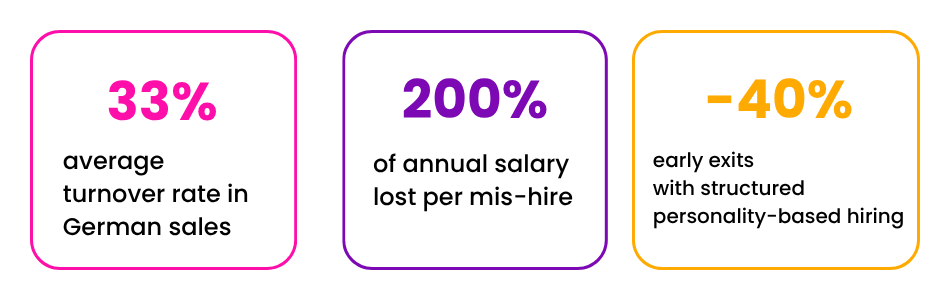
These are the decisions that determine whether your hires stay, grow, and contribute, or leave within twelve months and cost you 200% of their annual salary to replace.
Zortify was created to address exactly this challenge – not from a generic playbook, but from eight years of certified AI and psychometric research. It is designed for the European regulatory environment and validated specifically for roles where personality fit makes the difference between a good hire and an expensive mistake.
SEE THE DIFFERENCE
Try Zortify for yourself – free
Discover your own personality profile in 30 minutes. Real insights.
Prof. Dr. Florian Feltes is co-founder and co-CEO of zortify and a forerunner in AI-supported HR innovation. Together with his team, he develops intelligent personality diagnostics and helps companies identify the perfect candidates—without expensive assessments and without bias. His vision: a world in which every company can effortlessly form high-performance teams and create work environments that allow human potential to flourish.
You may also like
The Sales Gene – does it actually exist?
We have been hiring salespeople incorrectly for decades. Not because we lack talent, but because we have been searching for the wrong qualities. Imagine the salesperson you would hire tomorrow. You probably already have an image in mind: confident, charismatic, outgoing, quick-witted. Someone who lights up a room and turns strangers into customers before the coffee goes cold.
The mis-hire is not the problem. Not knowing what it costs you is.
Around 14% of all new hires fail. Most companies are aware of this. Far fewer know what it is actually costing them, or where the money is quietly leaking away. Most finance directors have never seen this number on a spreadsheet. It does not appear in the quarterly report or the cost-per-hire metric. And it is unlikely to be on the agenda for your next board meeting.
Beyond AI Support: Why HR Must Become a Decision Architect
What remains of HR once everything automatable has been automated? In his latest feature for Human Resources Manager (Issue 2/2026), Zortify co-founder Prof. Dr. Florian Feltes argues that process optimisation through AI is not enough – and explains how Decision Intelligence brings people decisions to where they matter most: the point of decision.
We have been hiring salespeople incorrectly for decades. Not because we lack talent, but because we have been searching for the wrong qualities.
Imagine the salesperson you would hire tomorrow. You probably already have an image in mind: confident, charismatic, outgoing, quick-witted. Someone who lights up a room and turns strangers into customers before the coffee goes cold.
That image is costing companies millions every year.
The “born salesperson” is one of the most persistent – and most expensive – myths in hiring. It influences who gets shortlisted, who receives the offer, and who leaves within six months. Because the myth feels so intuitive, it is rarely questioned.
Research has been challenging it for over thirty years. It is time the hiring process caught up.
The myth has a name – and a weak correlation
Ask most sales managers what makes a great salesperson, and extraversion is mentioned within the first thirty seconds. The gregarious, people-oriented personality. High energy. Natural conversationalist. Loves being around others.
The science presents a more complex picture. Research on the Five Factor Model of personality and sales performance has found that conscientiousness and openness are positively related to sales outcomes, while extraversion shows no statistically significant relationship. Meta-analytic evidence, spanning decades and hundreds of studies, consistently places extraversion’s predictive value for sales performance at around rho = 0.15. That is modest at best.
To put this in context: this is roughly half the predictive power of conscientiousness, and less than half the predictive power of self-efficacy. The person you overlook because they seemed too quiet in the interview may well be the one who outperforms everyone in six months.
“Conscientiousness showed consistent relationships with all job performance criteria for all occupational groups studied.”
Barrick & Mount · Personnel Psychology — 162 studies, N = 42,887
So if it is not extraversion, what actually predicts sales success?
Decades of research – including Zortify’s own validation study —consistently point to five dimensions. None of these are visible in a CV. Most are invisible in a standard interview. All are measurable.
01Self-Efficacy
Strongest predictor
Not confidence in the sense of bravado — but the internal conviction that you can handle what comes at you. In sales, it determines what someone does after the tenth rejection in a row.
02Conscientiousness
Quality guarantor
Self-discipline, reliability, and the tendency to follow through. In regulated environments like financial services and insurance, it is not just a performance predictor — it is a compliance safeguard.
03Optimism
Burnout shield
Not blind positivity — but a realistic, proactive attribution style. Someone with high optimism reads setbacks as temporary and draws lessons rather than resignation. In commission-based sales, it is a survival prerequisite.
04Resilience
Highest ROI in training
The ability to bounce back after setbacks. The World Economic Forum lists resilience as a top-three future skill. In sales, it has always been critical. The good news: it is trainable, with effect sizes of d = 0.50–0.60.
05Extraversion
Important — but overrated
Yes, it matters. No, it does not matter as much as you think. Ambiverts often outperform high extraverts in many sales roles. Hiring exclusively for the ‘born salesperson’ systematically overlooks candidates with higher actual performance potential.
The cost of getting this wrong
This is not an abstract academic debate. Every time a company hires on gut feeling and the wrong profile, the financial consequences are immediate and compounding.
The first-year attrition rate in insurance and financial services structural sales is among the highest of any sector. Research consistently shows that performance and well-being are best ensured when sales personnel can work with their strengths rather than their weaknesses – which means identifying those strengths before hiring, not six months later.
Companies that implement structured, personality-based selection processes consistently reduce early turnover by 25 to 40 percent. Not by hiring better people, but by making better decisions about the people they already have in front of them.
Three traits that appear to be strengths – but are not
Beyond the five positive dimensions, research identifies three behavioural risk factors that require specific attention in sales hiring, particularly in regulated industries. These are dangerous precisely because they can appear to be strengths in an interview.
High narcissism can present as charisma and drive. Manipulative tendencies can resemble persuasiveness. Impulsivity can seem like decisiveness. In the short term, these traits may produce results. In the longer term, they generate customer complaints, regulatory exposure, and toxic team dynamics – the kind that quietly erode culture and cost far more than any individual mis-hire.
Standard unstructured interviews are almost entirely blind to these risks. The Five Factor Model provides important insights into personality traits that work well within sales environments, but capturing the full picture requires looking beyond surface behaviour into the underlying personality structure.
So, does the sales gene exist?
Not in the way we imagine. There is no single trait, no charisma factor, no genetic lottery ticket that determines whether someone will succeed in sales. What does exist is a measurable personality profile – five dimensions that consistently differentiate top performers from early quitters, across industries, cultures, and thirty years of peer-reviewed research.
The good news is that three of these five dimensions are trainable. Self-efficacy, optimism, and resilience can all be developed through targeted interventions, with effect sizes (d = 0.50–0.60) representing some of the highest returns on investment of any HR development measure.
The implication is clear: companies that measure these dimensions at the point of hiring make better selection decisions. Companies that develop them after hiring retain better employees. Companies that do both stop treating turnover as inevitable and start treating it as the preventable outcome it actually is.
Sources
Barrick, M.R. & Mount, M.K. (1991). The Big Five personality dimensions and job performance. Personnel Psychology, 44(1). Link
Avey, J.B., Reichard, R.J., Luthans, F. & Mhatre, K.H. (2011). Meta-analysis of the impact of positive psychological capital. Human Resource Development Quarterly, 22(2). Link
Luthans, F. & Youssef-Morgan, C.M. (2017). Psychological capital: An evidence-based positive approach. Annual Review of Organizational Psychology. Link
Kottirre, J. & Blickle, G. (2024). Conscientiousness and sales performance. Personality and Individual Differences, 232. Link
Brandt, C. (2025). Personality and sales — customising careers for salespeople. Athens Journal of Psychology, 1(2). Link
Heidbrink, M. & Feltes, F. — Zortify Validation Study (2023–2025). Internal research, callcentre sales environment
FREE WHITEPAPER
Das Vertriebs-Gen
The full research behind the five dimensions – with practical recommendations for selection and development. Available in German.
Prof. Dr. Florian Feltes is co-founder and co-CEO of zortify and a forerunner in AI-supported HR innovation. Together with his team, he develops intelligent personality diagnostics and helps companies identify the perfect candidates—without expensive assessments and without bias. His vision: a world in which every company can effortlessly form high-performance teams and create work environments that allow human potential to flourish.
You may also like
The mis-hire is not the problem. Not knowing what it costs you is.
Around 14% of all new hires fail. Most companies are aware of this. Far fewer know what it is actually costing them, or where the money is quietly leaking away. Most finance directors have never seen this number on a spreadsheet. It does not appear in the quarterly report or the cost-per-hire metric. And it is unlikely to be on the agenda for your next board meeting.
Beyond AI Support: Why HR Must Become a Decision Architect
What remains of HR once everything automatable has been automated? In his latest feature for Human Resources Manager (Issue 2/2026), Zortify co-founder Prof. Dr. Florian Feltes argues that process optimisation through AI is not enough – and explains how Decision Intelligence brings people decisions to where they matter most: the point of decision.
The hire who did not stay – A Recruiter’s Perspective
The notification arrives on a Tuesday morning. The hiring manager wants to talk. You already sense the reason before the call connects. The person you placed four months ago has resigned.
To understand why early turnover affects recruiters differently, it is important to consider the conditions they already face.
The mis-hire is not the problem. Not knowing what it costs you is.
Around 14% of all new hires fail. Most companies are aware of this. Far fewer know what it is actually costing them, or where the money is quietly leaking away.
Most finance directors have never seen this number on a spreadsheet. It does not appear in the quarterly report or the cost-per-hire metric. And it is unlikely to be on the agenda for your next board meeting.
It is the true cost of your last bad hire.
Not the recruitment fee. Not the onboarding expense. The full cost – salary paid during underperformance, team productivity lost to compensation, manager time absorbed by damage control, and the cultural erosion that follows when the wrong person remains in the wrong role for six months too long.
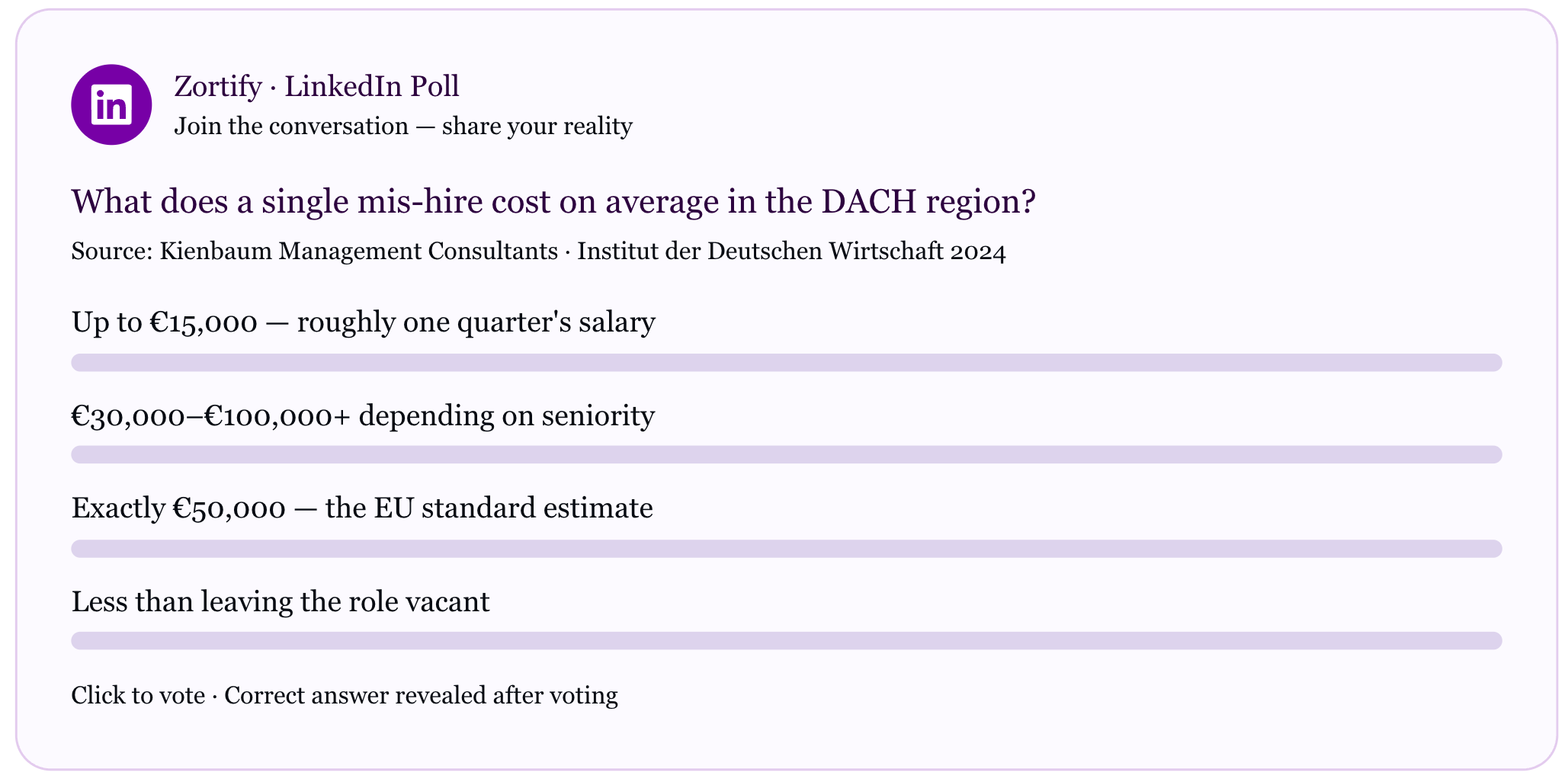
Industry research puts this figure at between 50% and 200% of annual salary. For a €60,000 role, that is between €30,000 and €120,000. Per hire. Per mistake.
“Managers are hired for their professional qualifications — and fired for their personality.”
Oxford Economics / HR Morning
The uncomfortable truth is that most hiring processes are designed to catch the first kind of problem and are almost entirely blind to the second.
The iceberg nobody talks about
The direct costs of a bad hire are real but relatively straightforward to calculate: recruitment expenditure, onboarding investment, months of salary during the notice period, and the cost of restarting the process. For a mid-level role, these direct costs alone routinely exceed €50,000.
However, these are just the tip of the iceberg. What lies beneath the surface is much larger – and far more damaging.
By the time a mis-hire becomes undeniable, six to twelve months have usually passed. During this period, the team has been compensating. Colleagues work longer hours, take on responsibilities that were never theirs, and grow quietly resentful. Stress levels rise, quality declines, and the risk of a domino effect – where your best people start looking elsewhere because they are tired of carrying the load – increases with every week the problem remains unaddressed.
The research is clear: high turnover creates a contagion effect. When one person leaves, the probability that others will follow increases significantly. A single mis-hire in a team of eight is not just a personnel problem; it is a structural risk.
“Bad hires are like a slow leak in the system. That is exactly why they often go unaddressed for so long.”
Calculate your real exposure
Before companies can solve a problem, they need to see it clearly. The calculator below takes three inputs – annual hires, average salary, and your estimated mis-hire rate – and shows you the financial exposure you are carrying right now, and what a more precise hiring process could save you.
Calculate your exposure
50
14%
Total annual cost of early turnover
€210k–€840k
7 mis-hires · 50–200% of avg. annual salary (€60k)
ROI comparison
Annual cost of mis-hires
€210k–€840k
Based on your mis-hire rate
Zortify investment
€31,125
Based on your hiring volume
Annual savings with Zortify
€63k–€252k
Based on avoiding 30% of mis-hires — minus Zortify investment.
Cost exposure based on 50–200% of avg. €60k salary per mis-hire · SHRM & Deloitte
Why companies keep spending money on the wrong things
Here is a paradox that most HR leaders recognise immediately: companies invest heavily in sourcing – job boards, agencies, LinkedIn – and comparatively little in the decision that actually determines whether the investment pays off.
The average cost per hire in Europe is around €4,700 (SHRM, 2022). The average cost of a bad hire is between €30,000 and €120,000. The spend ratio is inverted. Companies are over-investing in finding candidates and under-investing in selecting the right ones. This is not irrational; it is a visibility problem. Sourcing costs appear on invoices. Mis-hire costs are hidden in spreadsheets that nobody reads – spread across payroll, productivity metrics, manager time, and team health surveys that are rarely linked back to a hiring decision made nine months earlier.
The moment you make the invisible visible – as the calculator above does – the case for better selection becomes obvious. Not as an HR initiative, but as a capital allocation decision.
What better actually looks like
Improving hiring quality does not mean adding more interview rounds. Research consistently shows that additional unstructured interviews do not improve prediction accuracy; they primarily increase the cost and duration of the process while amplifying existing biases.
What improves outcomes is adding structured behavioural data at the right point in the process. Specifically, a personality assessment that goes beyond self-reported questionnaires to examine how a candidate actually thinks, communicates, and handles pressure.
Zortify's AI-based diagnostics – combining Natural Language Processing with validated Big Five, Entrepreneurial capital and Counterproductive behavioral tendencies psychometrics – fit naturally in the recruiting process and before the final decision. The output provides hiring managers with something they have rarely had before: an objective profile showing personality, working style, risk indicators, and entrepreneurial potential in a format clear enough to use in a debrief.
FROM OUR CLIENTS
Salonkee — 30% reduction in employee turnover after integrating Zortify into their recruitment process.
Crafts Unfolded — 33% reduction in time-to-hire. 100% culture-fit score across all assessed hires.
Saint Sass — 5 top talents hired in 4 weeks — 50% faster and up to 90% cheaper than the previous process.
The question every CFO should be asking HR
Finance tracks capital allocation precision. Operations tracks defect rates. If recruitment is the function that determines whether every other function has the right people to do their work, then recruitment must track decision accuracy.
Not time-to-fill. Not cost-per-hire. Decision accuracy – measured by quality of hire, first-year retention, and time-to-full-productivity.
These are the metrics that translate a hiring decision into a financial statement line. They are also the metrics that make the ROI of better selection tools undeniable.
A mis-hire is not the problem; it is a symptom. The real problem is treating hiring as a process to be completed, rather than a decision to be made well. The cost of that confusion – as the calculator above will show – is almost certainly greater than any other item on your HR budget.
See what better hiring looks like for your team.
Book a free 30-minute demo. We will run the numbers with you.
Prof. Dr. Florian Feltes is co-founder and co-CEO of zortify and a forerunner in AI-supported HR innovation. Together with his team, he develops intelligent personality diagnostics and helps companies identify the perfect candidates—without expensive assessments and without bias. His vision: a world in which every company can effortlessly form high-performance teams and create work environments that allow human potential to flourish.
You may also like
Beyond AI Support: Why HR Must Become a Decision Architect
What remains of HR once everything automatable has been automated? In his latest feature for Human Resources Manager (Issue 2/2026), Zortify co-founder Prof. Dr. Florian Feltes argues that process optimisation through AI is not enough – and explains how Decision Intelligence brings people decisions to where they matter most: the point of decision.
When someone leaves too soon – A Hiring Manager’s Perspective
You remember the moment you said yes. The candidate was sharp. The interview went well. The team liked them. You felt good about it – perhaps even excited. So when they hand in their notice six months later, it does not just feel like a business problem. It feels personal.
Recruiting has entered a paradox.
On one hand, organisations are overwhelmed by an unprecedented volume of applications. On the other, hiring managers still struggle to find candidates who truly match the role.
Why HR must make the leap to Decision Intelligence
AI has firmly arrived in HR departments. It speeds up screening, automates routine tasks, and generates interview guides. All measurable. All useful. But is it enough?
In a recent feature for Germany’s leading HR publication, Human Resources Manager (Issue 2/2026), I explore a question that is uncomfortable but unavoidable: what remains of HR once everything automatable has been automated? Here is the short version – the full analysis is available in the magazine.
The support trap
Payroll, time tracking, leave management, reference letters, applicant screening, reporting, onboarding – virtually all of this is automatable today. And yes, AI does it faster and better than any manual process ever could.
But there in lies the trap. Organisations that treat AI purely as a support tool for existing processes end up reinforcing structures that may themselves be the problem. Process optimisation is the surest way to preserve a structure that may have long been obsolete.
What organisations actually need
What companies lack most urgently is not faster administration. It is the ability to make sound people decisions – across the entire employee lifecycle.
The evidence is sobering. The majority of employers have experienced bad hires. Interviewers frequently form judgments within minutes. Unconscious bias significantly affects hiring decisions. In talent development, data-driven foundations are often missing. When it comes to retention, HR tends to be reactive rather than predictive.
The structural paradox is clear: HR holds the expertise, but others make the decisions. Hiring managers and leaders who are domain experts but rarely trained in interpreting diagnostic information or recognising cognitive bias. AI as a support tool for HR changes nothing about this paradox.
Decision Intelligence: bringing expertise to the point of decision
This is where AI must outgrow itself. Away from doing the legwork, towards Decision Intelligence: the systematic design of decision processes that integrate data analysis, behavioural science, and context-sensitive presentation.
Consider a practical example. Instead of delivering abstract personality scores to a hiring manager, a Decision Intelligence system provides context-specific recommendations – tailored to the team’s current dynamics and the role’s specific requirements. It generates individualised interview questions based on diagnostic findings. The manager does not receive a diagnosis. They receive actionable guidance that makes their conversation better.
The same logic applies to talent development, retention, and workforce planning. AI does not deliver reports – it generates concrete discussion prompts, detects early warning signals, and models scenarios. Right at the point of decision.
What blocks the shift: FOBO and FOBW
Beyond institutional hurdles – such as the design of works council agreements, a particularly pressing topic in 2026 across Europe – two psychological barriers stand in the way.
FOBO – Fear of Becoming Obsolete. The anxiety within HR teams that automation will render them redundant. As long as HR remains in the support role, this fear is rational. A support function that can be automated will be automated.
FOBW – Fear of Being Wrong. The reluctance of decision-makers to take responsibility for choices guided by technology they do not fully understand. Research shows that adoption depends less on model accuracy than on the design of the decision process. Systems that leave the final word with the user, explain their reasoning transparently, and allow for corrections lower FOBW substantially. Decision architecture beats model accuracy.
What remains of HR – and why it is more
Once administration, screening, and reporting are automated, what remains is precisely what machines cannot do. Designing decision architectures. Translating diagnostics into action. Bridging technology and employee representation. Reading culture, understanding dynamics, and building systems where human and artificial intelligence amplify each other.
AI will not replace HR. But it will replace the HR that settles for the support role. The function is indispensable. The form must change. And anyone waiting for technology to come to HR has already missed the moment to shape it.
This article is based on “Nach dem KI-Support” by Prof. Dr. Florian Feltes, published in Issue 2/2026 of Human Resources Manager (cover theme: “Support”). The full-length version is available in the magazine.
Prof. Dr. Florian Feltes
Prof. Dr. Florian Feltes is co-founder and co-CEO of zortify and a forerunner in AI-supported HR innovation. Together with his team, he develops intelligent personality diagnostics and helps companies identify the perfect candidates—without expensive assessments and without bias. His vision: a world in which every company can effortlessly form high-performance teams and create work environments that allow human potential to flourish.
You may also like
The hire who did not stay – A Recruiter’s Perspective
The notification arrives on a Tuesday morning. The hiring manager wants to talk. You already sense the reason before the call connects. The person you placed four months ago has resigned.
To understand why early turnover affects recruiters differently, it is important to consider the conditions they already face.
When someone leaves too soon – A Hiring Manager’s Perspective
You remember the moment you said yes. The candidate was sharp. The interview went well. The team liked them. You felt good about it – perhaps even excited. So when they hand in their notice six months later, it does not just feel like a business problem. It feels personal.
Recruiting has entered a paradox.
On one hand, organisations are overwhelmed by an unprecedented volume of applications. On the other, hiring managers still struggle to find candidates who truly match the role.
The notification arrives on a Tuesday morning. The hiring manager wants to talk. You already sense the reason before the call connects. The person you placed four months ago has resigned.
You review the process in your mind: sourcing, screening, interviews, offer. Everything went smoothly. They were qualified. They were enthusiastic. You felt confident about the match. Now you are back to the beginning – except it does not feel like a fresh start. It feels like a setback.
This is the aspect of recruiting that is rarely discussed.
A profession under pressure – before the call even comes
To understand why early turnover affects recruiters differently, it is important to consider the conditions they already face.
54% of recruiters report that their job has become more stressful in recent years. The burnout rate among recruiters reached 81% in 2024. They are managing time-to-fill targets, hiring manager expectations, candidate experience, and the constant pressure to move quickly without making costly mistakes – often all at once.
According to the Recruiter Nation Report, 44% of talent acquisition professionals cite competitive pressure as a primary source of stress. And that is before a hire leaves early.
When someone resigns within the first year, the pressure does not disappear; it compounds. There is self-doubt – did I overlook something? There is defensiveness – the process was thorough. And sometimes, quietly, there is a shift: towards safer choices, towards candidates who look good on paper rather than those who genuinely fit. That shift, over time, makes the problem worse.
What the data is actually telling us
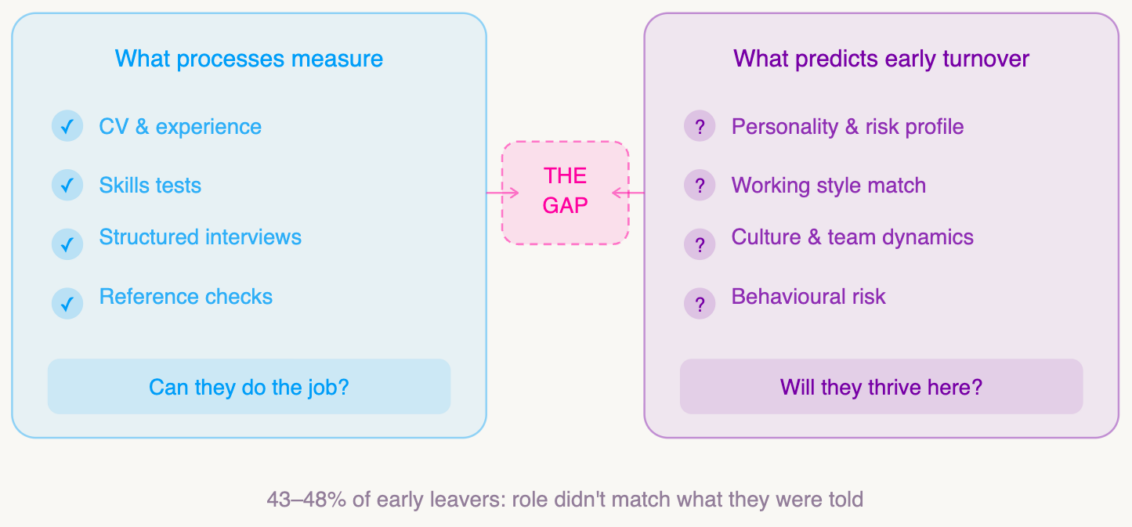
Between 38% and 52% of all employee turnover occurs within the first twelve months. 20% happens within the first 45 days. Early attrition peaks at the 12-month mark – just when the investment in onboarding and ramp-up has been made, but before full productivity has been achieved.
The most cited reasons are misaligned expectations (43–48% of early leavers say the role did not match what they were told), poor onboarding, lack of development, and cultural mismatch.
Notice what is largely absent from that list: skills. The person often could do the job. The problem was everything surrounding the job – how it was presented, what the environment actually felt like, whether the person’s personality genuinely suited the demands of the role and the dynamics of the team.
That is a fit problem. And fit is harder to assess than qualifications.
The accountability gap nobody discusses
This is particularly challenging for recruiters: quality of hire is increasingly tracked as a formal KPI, yet the tools to measure fit before hiring are rarely provided.
Companies now use first-year attrition as a direct measure of recruitment effectiveness. Recruiters are evaluated on whether their hires stay and perform, yet most are still left to assess personality, culture fit, and behavioural risk using intuition, body language, and a gut feeling formed in forty-five minutes.
It is not that recruiters lack perception; rather, the tools simply do not match the questions they are expected to answer.
Poor hires who are not a good fit for the role lead to higher attrition rates, damage to employer brand, and a perpetuating cycle of sourcing and re-hiring. The recruiter bears a disproportionate share of that reputational burden – internally with hiring managers, and externally with candidates who encounter an organisation unable to retain its people.
Unconscious bias: the hidden variable
Without structured behavioural data, recruiters – like all humans – tend to favour candidates who feel familiar, those who mirror their communication style, energy, or background. We call it chemistry. Sometimes it is; often, it is a blind spot.
Research consistently confirms this. Unstructured interviews are among the weakest predictors of job performance, yet they remain the dominant hiring method. The result is not just a higher risk of mis-hire – it is a systematically skewed talent pool, where decisions are influenced more by similarity than by suitability.
For recruiters who care about both quality and equity, this is a genuine professional frustration. They know something is missing; they just do not always have the means to fill the gap.
A better starting point
What would it look like to enter every interview with actual personality data in hand?
Not as a replacement for the conversation, but as a foundation for it. An objective profile that shows how a candidate tends to handle pressure and ambiguity, how they communicate and collaborate, where their risk tendencies lie, and how their working style aligns with the realities of the role.
This is what AI-based personality assessment makes possible. At Zortify, we have built exactly this kind of tool – designed to fit naturally after the first interview, giving recruiters and hiring managers a consistent behavioural layer across every role. One framework. One shared language. Insights clear enough to use in a debrief.
The result is not just fewer early departures. It is a different kind of conversation during the process – one that identifies fit before it becomes an issue. For recruiters, it offers something equally valuable: a defensible, data-backed basis for every recommendation they make.
The hire who stays
The best outcome in recruitment is not simply filling a position. It is hiring someone who, after six months, is developing – someone the team is pleased to have, and who cannot imagine being anywhere else.
That outcome is possible more often than current attrition rates suggest. However, it requires moving beyond the CV and first impressions. It means making personality a genuine, structured part of decision-making.
For recruiters, this is not just a process improvement. It is protection – for the candidate, for the team, and for the professional credibility that every good recruiter spends years building.
The hire who did not stay is a hard lesson. It does not have to be repeated.
Prof. Dr. Florian Feltes
Prof. Dr. Florian Feltes is co-founder and co-CEO of zortify and a forerunner in AI-supported HR innovation. Together with his team, he develops intelligent personality diagnostics and helps companies identify the perfect candidates—without expensive assessments and without bias. His vision: a world in which every company can effortlessly form high-performance teams and create work environments that allow human potential to flourish.
You may also like
When someone leaves too soon – A Hiring Manager’s Perspective
You remember the moment you said yes. The candidate was sharp. The interview went well. The team liked them. You felt good about it – perhaps even excited. So when they hand in their notice six months later, it does not just feel like a business problem. It feels personal.
Recruiting has entered a paradox.
On one hand, organisations are overwhelmed by an unprecedented volume of applications. On the other, hiring managers still struggle to find candidates who truly match the role.
Around 14% of all new hires fail. With 50 hires per year, this can quickly add up to over $300,000 in direct costs. And that’s just the tip of the iceberg. The real damage become apparent later: declining team performance, lost innovation, and a domino effect that drives top performers to competition. Bad hires are like a slow leak in the system.
The candidate was sharp. The interview went well. The team liked them. You felt good about it – perhaps even excited. So when they hand in their notice six months later, it does not just feel like a business problem. It feels personal.
Early turnover is one of the most quietly painful experiences in management. It is far more common than most organisations acknowledge.
The numbers behind the feeling
Research shows that between 38% and 52% of all employee turnover occurs within the first twelve months. 31% of new hires leave before reaching the six-month mark. Perhaps most strikingly, 70% of employees decide whether a job is truly a good fit within their first thirty days.
That is not a ramp-up period. That is a verdict.
For hiring managers, the cost goes well beyond the numbers – though those are significant too. Replacing an employee typically costs between 33% and 400% of their annual salary. Mid-level staff can take six to twelve months to reach full productivity. Every early exit resets that clock.
But the real damage often happens somewhere less visible.
What it does to a team
When someone leaves early, the team feels it – even if no one says anything.
There is the practical disruption: redistributed workload, onboarding a replacement, and lost institutional knowledge. But beneath that lies something harder to measure: a quiet erosion of trust, a slight pull towards cynicism. “We have been through this before. Why would this time be any different?”
High turnover creates a domino effect. Remaining employees become more stressed, more stretched, and – research confirms – more likely to leave themselves. The team once energised by a new hire is now quietly calculating how long they want to stay.
And the hiring manager sits in the middle of it all.
The story nobody tells
Here is the version of events that rarely appears in an exit interview:
A hiring manager spends weeks on the process. They review CVs, conduct interviews, sell the role, and negotiate the offer. They invest real energy in someone. When that person leaves, the manager does not just lose a team member – they lose confidence. They start second-guessing their instincts. They wonder what they missed.
Often, what they missed was not visible in the interview at all.
Skills can be assessed. Experience can be verified. But personality – how someone handles pressure, navigates conflict, responds to feedback, or reacts when expectations do not match reality – is much harder to uncover in a sixty-minute conversation.
Between 43% and 48% of employees who leave early cite a gap between how the role was described and what it actually turned out to be. This is not always due to dishonesty. Often, it is a genuine mismatch in expectations, values, or working style that neither side could fully articulate during the hiring process.
From instinct to insight
The question is not whether hiring managers care about fit – they do, deeply. The real question is whether they have the right tools to evaluate it.
Gut feeling is not the enemy. However, gut feeling shaped by unconscious bias, time pressure, and a sixty-minute conversation is a fragile foundation for a decision that will affect a team for years.
This is where structured personality diagnostics make a difference. Not as a replacement for human judgement, but as a complement – an objective layer that makes what is usually invisible, visible.
Understanding a candidate’s personality profile, working style, approach to risk and conflict, and natural strengths and blind spots gives hiring managers something they have rarely had before: a shared language for fit, grounded in data.
At Zortify, this is exactly what we have been building since 2018—AI-based personality assessment that provides hiring teams with consistent, interpretable insights across every role and department. Not a complex report that gets ignored, but a clear, actionable foundation for better decisions.
The conversation that changes everything
Imagine going into a debrief not just asking, “Did we like them?” but, “Does their personality profile align with what this role actually demands and what this team actually needs?”
That conversation changes who gets hired. It also changes what gets built: teams with genuine complementarity, resilience, and a real chance to grow together.
Early turnover is painful, but it is not inevitable.
The first step is recognising that fit is not a feeling. It is a discipline – and one that every hiring manager deserves the tools to practise well.
Prof. Dr. Florian Feltes
Prof. Dr. Florian Feltes is co-founder and co-CEO of zortify and a forerunner in AI-supported HR innovation. Together with his team, he develops intelligent personality diagnostics and helps companies identify the perfect candidates—without expensive assessments and without bias. His vision: a world in which every company can effortlessly form high-performance teams and create work environments that allow human potential to flourish.
You may also like
The new recruiting paradox
Recruiting has entered a paradox.
On one hand, organisations are overwhelmed by an unprecedented volume of applications. On the other, hiring managers still struggle to find candidates who truly match the role.
Around 14% of all new hires fail. With 50 hires per year, this can quickly add up to over $300,000 in direct costs. And that’s just the tip of the iceberg. The real damage become apparent later: declining team performance, lost innovation, and a domino effect that drives top performers to competition. Bad hires are like a slow leak in the system.
Bias out. ROI in: The unexpected win of AI regulation
How AI in recruiting went from being a mere tool to a driver of the future.
February 2025. While some companies are frantically reviewing their AI-supported recruiting processes to meet the EU AI Act requirements at the last minute, others are remaining calm. They have used the previous months not only to ….
Too many applications – and still not enough talent
Recruiting has entered a paradox.
On one hand, organisations are overwhelmed by an unprecedented volume of applications. On the other, hiring managers still struggle to find candidates who truly match the role.
For HR leaders and decision-makers, this creates a costly ambiguity: more candidates to review, but less certainty about who will actually succeed in the role.
This article explores why this paradox is emerging – and how organisations can adapt their hiring strategies to make faster and more reliable decisions.
The application flood: when AI multiplies candidate volume
Generative AI has dramatically lowered the barrier to applying for jobs.
Candidates can now generate tailored CVs and cover letters in seconds and apply to dozens – sometimes hundreds – of positions automatically. As a result, application volumes have surged across industries.
What used to be a scarcity problem – not enough candidates – is increasingly becoming a signal-to-noise problem.
For HR teams, this means:
More CVs to review
Less differentiation between applicants
More time spent verifying authenticity
In short, volume has increased, but informational value has decreased.
At the same time, the talent shortage has not disappeared.
Paradoxically, the surge in applications does not mean that organisations suddenly have access to more qualified talent.
Across industries, companies still report significant skill shortages, particularly for leadership roles, technical expertise, and complex knowledge work.
Structural factors driving this scarcity include:
demographic shifts and shrinking workforces in many developed economies,
rapidly evolving skill requirements,
growing demand for digital and AI-related capabilities.
In emerging fields, demand is increasing faster than the supply of talent. For example, research on labour market trends shows that demand for AI-related roles has grown significantly in recent years, while qualified professionals remain scarce.
The result is dual pressure on recruitment teams:
Too many applications to process
Too few truly qualified candidates
This paradox creates a hidden operational risk.
The real business risk: expensive hiring mistakes
When signal quality declines, hiring decisions become more uncertain, increasing the likelihood of costly mis-hires. The financial consequences are substantial:
Mis-hires can incur six-figure indirect costs when considering salary, lost productivity, team disruption, and replacement hiring.
Poor leadership hires can destabilise projects, increase turnover, and damage client relationships.
In environments where candidates appear equally qualified on paper – a situation increasingly common with AI-generated applications – decision-making often shifts towards subjective impressions.
This is where the real risk arises.
Because, the more similar candidates seem at the application stage, the more decision quality relies on the depth and structure of the evaluation process.
Why traditional screening methods are reaching their limits
Traditionally, recruiters have relied on three main signals:
CV experience
Educational background
Interview impressions
However, generative AI has undermined the reliability of the first two. AI-generated CVs can present highly polished narratives, making candidates appear more qualified than their actual experience indicates. Recruiters are increasingly faced with applications that look impressive but reveal little about genuine behavioral patterns or long-term performance potential.
At the same time, interviews alone are often insufficient to resolve this ambiguity.
Interview outcomes can vary widely depending on:
the interviewer,
the questions asked,
unconscious bias,
and the candidate’s level of preparation.
Without structured decision frameworks, hiring panels frequently end up debating perceptions rather than evidence.
A new standard: moving from Screening to Prediction
To navigate this new environment, many organisations are shifting their hiring strategy from simple screening to predictive evaluation.
Instead of asking only, “Does this candidate look qualified?” the more relevant question becomes, “Based on reliable signals, how likely is this candidate to succeed in this role?”
This is where predictive assessment and structured diagnostics are gaining importance. Research shows that AI-supported recruitment tools can improve hiring accuracy by up to 40% and increase candidate matching quality by 67% when used appropriately within the decision process.
However, technology alone is not the solution.
The real value emerges when predictive insights are integrated into a structured decision logic that hiring managers can use consistently.
Turning data into better hiring decisions
Forward-looking organisations are therefore introducing an additional layer of diagnostic insight into their hiring process. Platforms such as Zortify take this approach by combining validated psychometric measurement with AI-supported analysis of open-text responses.
Rather than replacing interviews, this creates a structured evaluation framework that provides decision-makers with insights into:
personality structure
resilience and entrepreneurial mindset
cultural alignment
potential counterproductive tendencies
These insights serve as evidence-based signals that help hiring managers move beyond CV narratives and interview impressions.
The goal is not to automate decisions, but to enable better-informed decisions.
When predictive diagnostics are integrated early in the process, interviews become more focused, comparisons between candidates become more transparent, and discussions within hiring panels shift from opinion to evidence.
The future of recruiting: clarity in a noisy market
The recruiting landscape will likely remain complex.
Generative AI will continue to increase application volume, while demographic and economic factors will sustain pressure on talent supply. This presents HR leaders with a structural challenge: how to identify real potential in a market full of polished but increasingly similar applications.
Organisations that succeed will not necessarily be those with the fastest hiring processes, but those with the clearest decision standards – standards that allow hiring managers to distinguish between candidates who look strong on paper and those most likely to perform and grow in the role.
In an environment where both candidates and companies use AI, the competitive advantage will belong to organisations that combine human judgement with reliable predictive insights.
In the end, the real goal of recruiting has not changed: not hiring faster, but hiring right.
Prof. Dr. Florian Feltes
Prof. Dr. Florian Feltes is co-founder and co-CEO of zortify and a forerunner in AI-supported HR innovation. Together with his team, he develops intelligent personality diagnostics and helps companies identify the perfect candidates—without expensive assessments and without bias. His vision: a world in which every company can effortlessly form high-performance teams and create work environments that allow human potential to flourish.
You may also like
Budget killer bad hires
Around 14% of all new hires fail. With 50 hires per year, this can quickly add up to over $300,000 in direct costs. And that’s just the tip of the iceberg. The real damage become apparent later: declining team performance, lost innovation, and a domino effect that drives top performers to competition. Bad hires are like a slow leak in the system.
2025 Check-Out with Marcus & Florian, CEOs of Zortify
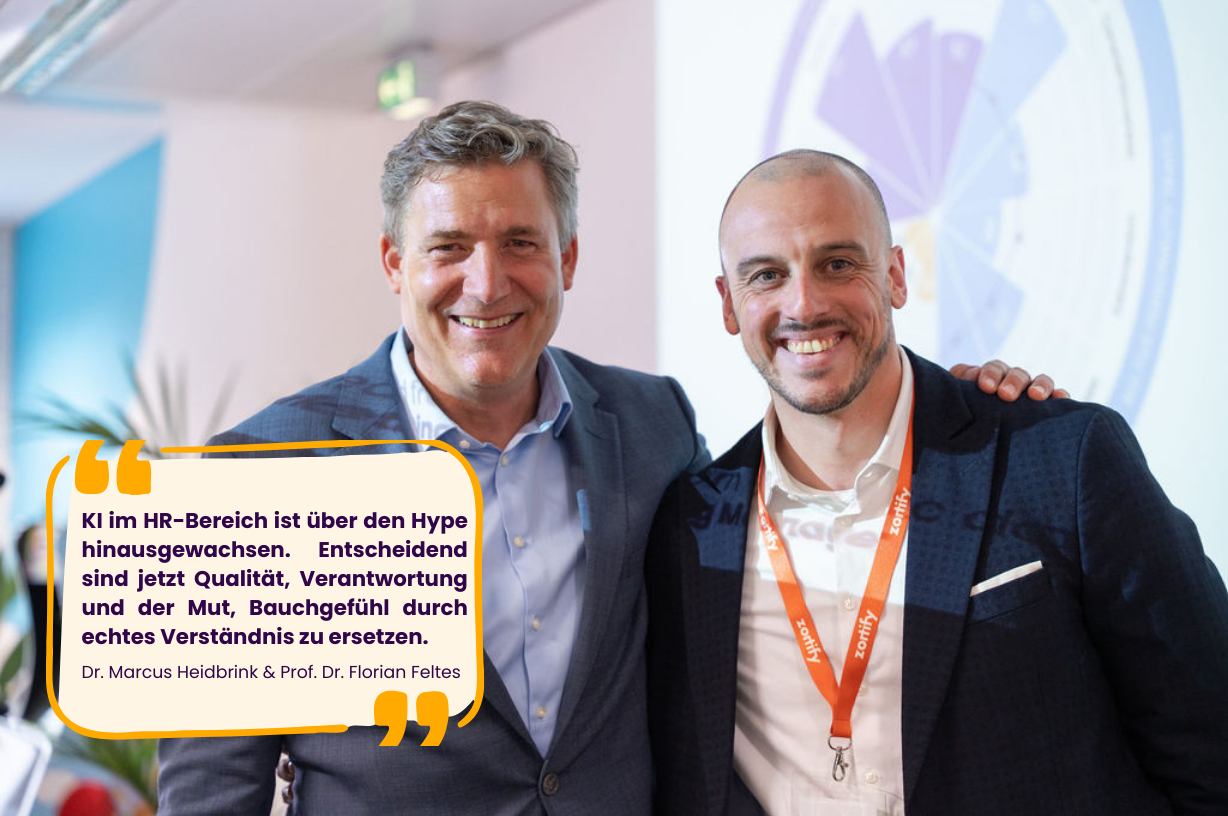
What do you think: Beyond the hype – where does the HR industry really stand today when it comes to AI?
Marcus: Looking at the big picture, I believe the fundamental question “Do we use AI in recruiting?” has been answered clearly. The focus is now shifting to the question: “How good are the AI systems we use?”
Bias out. ROI in: The unexpected win of AI regulation
How AI in recruiting went from being a mere tool to a driver of the future.
February 2025. While some companies are frantically reviewing their AI-supported recruiting processes to meet the EU AI Act requirements at the last minute, others are remaining calm. They have used the previous months not only to ….
How companies can easily improve their hiring process
Around 14% of all new hires fail. With 50 hires per year, this can quickly add up to over $300,000 in direct costs. And that’s just the tip of the iceberg. The real damage become apparent later: declining team performance, lost innovation, and a domino effect that drives top performers to competition. Bad hires are like a slow leak in the system. That’s exactly why they often go unaddressed for a long time. It’s time to change that.
The domino effect: from the wrong hire to crisis
The obvious costs are clear: recruiting expenses, onboarding, months of salary, and a new hiring process. Studies estimate the replacement costs – depending on the role and seniority – at 50% to four times the annual salary.
But even these figures fall short. By the time a bad hire becomes apparent, six to twelve months have often already passed. During this time, the team has to compensate, for example by working longer hours and putting in more effort to coordinate. stress level rise, quality declines, and the risk of exhaustion and burnout increase structurally. The important thing to note is that the damage rarely affects just one person. Bad hires can trigger chain reactions that destabilize entire departments. At this point, at the latest, it becomes clear that is not a “soft” cultural issue, but rather the measurable business of hiring decisions.
Skills-first meets personality-first
Many organizations still focus too much on applicants’ professional qualifications and too little on what really make people successful in everyday life: ownership, integrity, resilience, learning ability, and collaboration. Oxford Economics sums it up succinctly: Managers are hired for their professional qualifications – and fired for their personality. The solution is not either/or, but a smart combination:
Skills-based to ensure the professional foundation,
Personality-based to increase the likelihood of sustainable performance.
Important: It’s not about testing more, but about making better decisions. The key lies in the predictability of performance.
From gut feeling to measurable results
This is where this AI-supported diagnostics come in: they can significantly increase the quality of professional performance forecasts. Companies report 31% faster hiring times with AI tools, 50% better quality of hire, and with proper implementation – 50-61% less unconscious bias.
How personality-based recruiting works:
NLP instead of multiple choice: AI analyzes open-ended text responses. The results are less socially desirable and closer to actual thinking and communication logic.
Big 5 Model: Scientifically validated, the model measures business-critical characteristics like openness, conscientiousness, extraversion, agreeableness, and emotional stability.
Entrepreneurial Capital: Analysis of urgently needed characteristics
in a rapidly changing environment, such as resilience, self-efficacy, optimism, and agility mindset.
Counterproductive Behavior Tendencies: Measurement of risk factors like
strategic manipulative beahvior and impulsivity.
Cultural fit: Comparison of personality with the values and working methods of the company
Instead of “it’ll do,” organizations receive data-based probabilities of success, enabling them to plan to plan team capacities and implement projects more reliably. The KPIs are clear: shorter time-to-fill, higher offer acceptance rate, better quality of hire, higher retention rate, and shorter time-to-productivity. The latter in particular is often underestimated: suitable employees become productive more quickly.
HR: From process owner to decision-making authority
When recruiting is understood as strategic value creation, the role of HR automatically changes. HR is then no longer the authority that coordinates appointements and guides process steps, but rather the function that sets the decision-making standard. This means that HR is not only responsible for ensuring that hiring takes place, but also that it is of high quality, i.e., transparent and business-relevant. HR ensures governance, fairness, and compliance without losing speed.
More stability, less rework, more leadership capacity
In the long term, this creates a system that not only fills positions faster, but also better. Fewer miscasts mean less friction, more stable teams, and more leadership capacity for value creation instead of damage control.
Companies that modernize their decision-making standards in 2026 will gain an advantage in a working world where adaptability, responsibility, and cultural fit determine competitiveness.
Download the whitepaper “The business impact of fast and precise recruiting decisions”
Prof. Dr. Florian Feltes
Prof. Dr. Florian Feltes is co-founder and co-CEO of zortify and a forerunner in AI-supported HR innovation. Together with his team, he develops intelligent personality diagnostics and helps companies identify the perfect candidates—without expensive assessments and without bias. His vision: a world in which every company can effortlessly form high-performance teams and create work environments that allow human potential to flourish.
You may also like
1 in 700 is not enough! – How companies really hire based on skills
Three-quarters of companies have announced in recent years that they will evaluate candidates more on the basis of their actual skills and competencies rather than formal qualifications. However, a Harvard study shows a clear discrepancy between promises and reality.
2025 Check-Out with Marcus & Florian, CEOs of Zortify
What do you think: Beyond the hype – where does the HR industry really stand today when it comes to AI?
Marcus: Looking at the big picture, I believe the fundamental question “Do we use AI in recruiting?” has been answered clearly. The focus is now shifting to the question: “How good are the AI systems we use?”
Bias out. ROI in: The unexpected win of AI regulation
How AI in recruiting went from being a mere tool to a driver of the future.
February 2025. While some companies are frantically reviewing their AI-supported recruiting processes to meet the EU AI Act requirements at the last minute, others are remaining calm. They have used the previous months not only to ….
Bias out. ROI in: The unexpected win of AI regulation
Looking back on 2025: How AI in recruiting went from being a mere tool to a driver of the future
February 2025. While some companies are frantically reviewing their AI-supported recruiting processes to meet the EU AI Act requirements at the last minute, others are remaining calm. They have used the previous months not only to ensure compliance, but also to fundamentally rethink how technology should be used in recruiting.
Twelve months later, it will become clear that these different approaches have divided the industry into those who truly understand AI in recruiting and those who primarily view it as a technical and/or compliance challenge.
2025: The year of coming of age
The beginning of the year was marked by uncertainty: How do we meet the AI Act requirements? Will we have to shut down our systems? How expensive will that be? But over the course of the year, the most successful companies realized that regulation was not the problem, but rather the solution to the real problem: non-transparent, unfair recruiting processes that overlook potential and reproduce bias.
The pioneers of the HR industry saw the requirements of the EU AI Act as an opportunity. They have not only made their recruiting technology compliant, but also fundamentally improved it. Saint Sass, for example, one of Europe’s most sought-after fashion labels, switched to data-based personality analysis during a critical growth phase and was able to fill five key positions in just four weeks, 50% faster than the startup average, with 50% fewer interviews. Or the CHAPTERS Group, an investment company that specifically builds start-up teams. It uses AI-supported assessments to identify who really brings entrepreneurial thinking and action to the table – and achieved a 25% higher interview-to-hire ratio in 2025.
What these success stories have in common is that they have understood that transparency, traceability, and human oversight are not bureaucratic hurdles, but quality characteristics of excellent recruiting.
The learning curve of the HR industry
2025 was also a year of painful lessons. Companies that had implemented AI tools hastily and without careful consideration had experiences they would rather have avoided: algorithms that reinforced existing biases instead of minimizing them. Black box systems that no one in the company really understood. Candidates who felt devalued by non-transparent processes and withdrew their applications.
The industry has learned that not all AI is the same. The crucial difference lies in the underlying technology and philosophy. While CV parsing systems enable historical patterns and, as a result, often discrimination, language-based personality analysis takes a different approach. It does not evaluate which universities are listed on a resume or which company names are impressive, but rather how people communicate, think, and solve problems. It reveals what traditional methods overlook: intrinsic motivation, teamwork skills, willingness to learn, and entrepreneurial thinking.
The ROI of ethical AI
Responsible AI is not only ethically imperative, it also makes good business sense. By 2025, more and more companies will have recognized this. In times when a bad hire can quickly cost six-figure sums and a shortage of skilled workers is becoming a limiting factor for growth, quality of hire is the decisive metric.
Companies that invested in transparent, explainable AI systems in 2025 report measurable improvements: shorter time-to-hire with higher accuracy, lower turnover in the first twelve months, and more diverse teams without pressure to meet quotas. The ROI comes not from maximum automation, but from better decisions.
The companies that understand this are likely to win the war for talent. Not despite the AI Act requirements, but because of them.
Outlook for 2026: Mastering technology and human understanding
What does this mean for 2026? The fundamental question of “Do we use AI in recruiting?” has been answered. The focus is shifting to “How good is our AI?” Quality standards for recruiting technology will become established, not only through regulation, but also through measurable business impact.
2026 will be the year when AI becomes invisible in recruiting, but in the best sense. It will become as commonplace as email, but its quality will be the decisive differentiating factor. The leading companies will be those that think beyond compliance and use AI strategically: for potential prediction instead of CV screening, for team fit analyses instead of isolated individual assessments, for holistic people analytics instead of stand-alone solutions.
Recruiters will continue to evolve into curating decision-makers who combine data-driven insights with human judgment. Empathy, contextual understanding, and strategic thinking will become more important, not less. The best HR departments will be those that master technology and people skills to an equal degree.
The foundation has been laid
2025 was the year that set the course. Companies that are now on the right side of this development – with transparent, fair, effective AI – have a competitive advantage that will be decisive in 2026. While they are already working on the next generation of recruiting innovation, others are still struggling with the basics.
The year AI came of age in recruiting is also the year recruiting became more human. This apparent paradox is the real innovation: technology at the service of better human decisions.
What a wonderful prospect for the coming year.
Prof. Dr. Florian Feltes
Prof. Dr. Florian Feltes is co-founder and co-CEO of zortify and a forerunner in AI-supported HR innovation. Together with his team, he develops intelligent personality diagnostics and helps companies identify the perfect candidates—without expensive assessments and without bias. His vision: a world in which every company can effortlessly form high-performance teams and create work environments that allow human potential to flourish.
You may also like
1 in 700 is not enough! – How companies really hire based on skills
Three-quarters of companies have announced in recent years that they will evaluate candidates more on the basis of their actual skills and competencies rather than formal qualifications. However, a Harvard study shows a clear discrepancy between promises and reality.
Predicting retention: How companies can avoid costly employee turnover
In many organizations, the actual costs of turnover are overlooked in recruitment strategies. While enormous resources are invested in job profiles, hiring funnels, and assessment processes, one crucial question remains unanswered: Will the person hired today still be with the company in 18 months?
How talent stands out and companies recognize who really fits.
The application sounds flawless. Every word is perfect. Every phrase hits the right note. And that’s exactly the problem. Since ChatGPT & Co. have reached the application process, documents are becoming increasingly similar.