
2025 Check-Out with Marcus & Florian, CEOs of Zortify
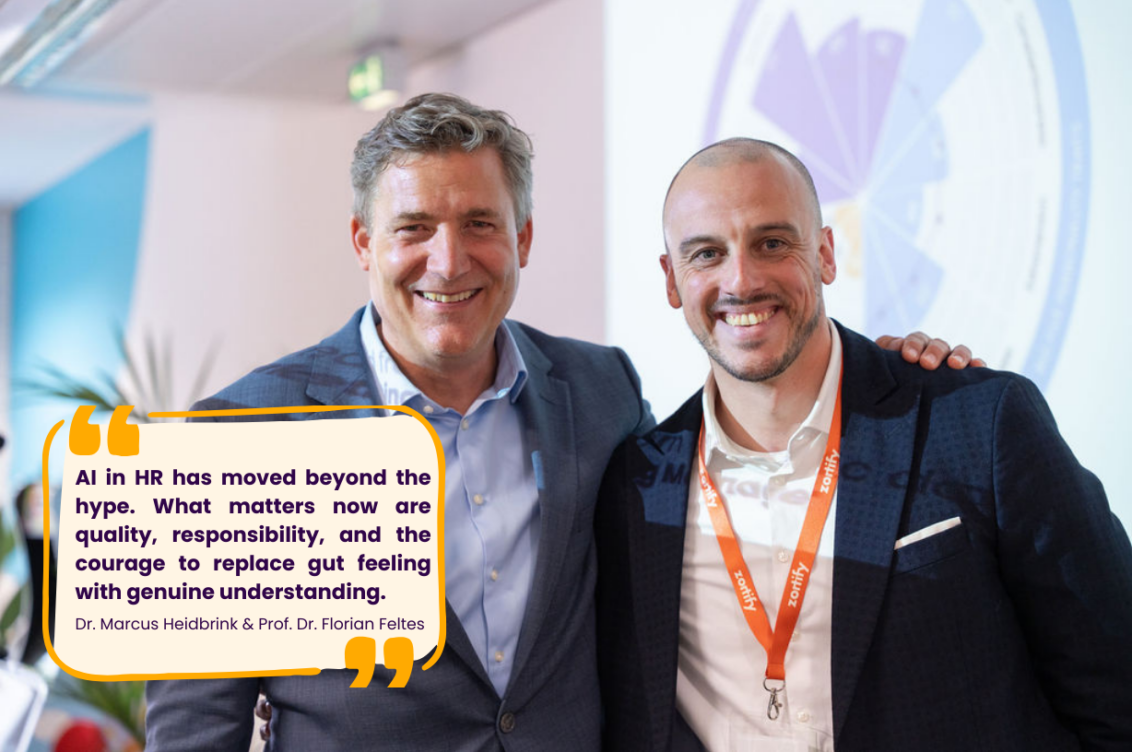
What do you think: Beyond the hype – where does the HR industry really stand today when it comes to AI?
Marcus: Looking at the big picture, I believe the fundamental question “Do we use AI in recruiting?” has been answered clearly. The focus is now shifting to the question: “How good are the AI systems we use?” Companies need to learn to ask the right questions when selecting AI providers. This is especially true in light of the EU AI Act, which sets out clear requirements for ethical use in HRM and has been binding since February 2025. The pioneers in the HR industry have embraced the requirements of the EU AI Act as an opportunity. They have not only made their recruiting technology compliant, but have fundamentally improved it.
Florian: Many companies are currently undergoing restructuring processes. AI is primarily used here to increase efficiency and optimize performance management workflows. At the same time, the introduction of such technologies leads to intensive discussions with works councils to ensure that all processes are implemented in a legally compliant and transparent manner. I think the learning curve among HR professionals is higher than it has been in a long time.
In your opinion, which assumption about AI in HR has turned out to be wrong in 2025?
Florian: The expectation that AI would already have made a massive breakthrough in HR processes has not been fulfilled. Instead, it is becoming clear that sensitivity to regulatory frameworks – such as the EU AI Act – as well as data protection and employee participation are essential. AI can only have a lasting effect if these factors are taken into account from the very beginning.
Marcus: In the past, the term “AI” was used as a synonym for “automation.” By 2025, I had heard less and less of the assumption that AI only adds value by improving efficiency and facilitating highly standardized tasks. With Zortify, we not only accelerate the psychological assessment process, but also improve the quality of recruitment decisions.
How do you think AI tools have changed the role of HR managers – and where is it heading?
Florian: HR managers today need significantly more expertise in legal and data-related issues. They also need to understand the models on which the tools they use are based in order to assess their actual added value and recognize their limitations. The role is thus evolving from pure process control to a strategic-analytical function.
What will be the biggest challenge for people management in the next two years?
Marcus: I think the biggest challenge will be integrating AI into learning and development processes and scaling the benefits of these technologies across the organization. This requires a high degree of internal stakeholder management and strategic communication.
What skill do you think will be indispensable for managers in 2026?
Florian: Active listening and truly understanding—that will be the key skill for making decisions that will help organizations stay ahead of the curve. AI will be the enabler here, supporting informed decisions without replacing the human perspective.
Marcus: Last year, we measured increasingly lower levels of optimism with Zortify. I find this an alarming signal. What happens to companies or teams whose bosses are not confident? I consider it an indispensable skill for all managers to lead themselves. In today’s world, this also means managing one’s energy professionally and constantly rebuilding and communicating one’s own confidence.
Was there a moment when you fundamentally questioned your strategy?
Florian: Not in terms of content, but rather our go-to-market approach had to be adjusted. Reality showed that sales cycles take longer than expected, a factor that we had to strategically reconsider.
What customer feedback challenged you the most or made you rethink your strategy?
Marcus: Feedback such as, “I listen to my gut feeling; we don’t need psychological diagnostics,” is particularly challenging. Statements like this force us to communicate the benefits of our tools even more clearly and explain HR decisions based on data.
Where do you see the greatest untapped potential in the HR tech industry?
Florian: I see great potential in democratizing HR understanding. Issues such as employee selection, culture, and leadership should not only be initiated by HR. They must be embedded throughout the entire organization.
What would you like to do differently in 2026?
Florian: I want to share more market perspectives and feedback to empower even more people. “Radical candor” is central to this. Personally, I’m paying more attention to sports again. Cardio training helps me organize my thoughts, and playing soccer with friends is the perfect way to completely switch off. This increases my performance, resilience, and mood and has a positive effect on my work.
Marcus: I want to spend more time with our colleagues in the new year.